
- Case counts (2016-2025), population estimates (2016-2023), & population projections (2024-2025): Public Health Ontario.
- Query: Case counts of reportable diseases by public health unit and year. Toronto, ON: Ontario Agency for Health Protection and Promotion; extracted on March 9, 2026.
Verotoxin-producing E. coli, including Hemolytic Uremic Syndrome
VTEC
Verotoxin-producing Escherichia coli (VTEC) is a form of the bacteria E. coli that causes gastrointestinal illness. It can be found in cattle, as well as some other animals. VTEC is spread to humans through eating or drinking contaminated food or water, or by contact with animals and their environments (e.g., farms or petting zoos). It can also spread from person to person.
Complications may include hemolytic uremic syndrome (HUS). HUS is a serious disorder that usually occurs in children and involves the formation of small blood clots throughout the body that block the flow of blood to vital organs such as the brain, heart, and kidneys.
Local Information
2025 Statistics
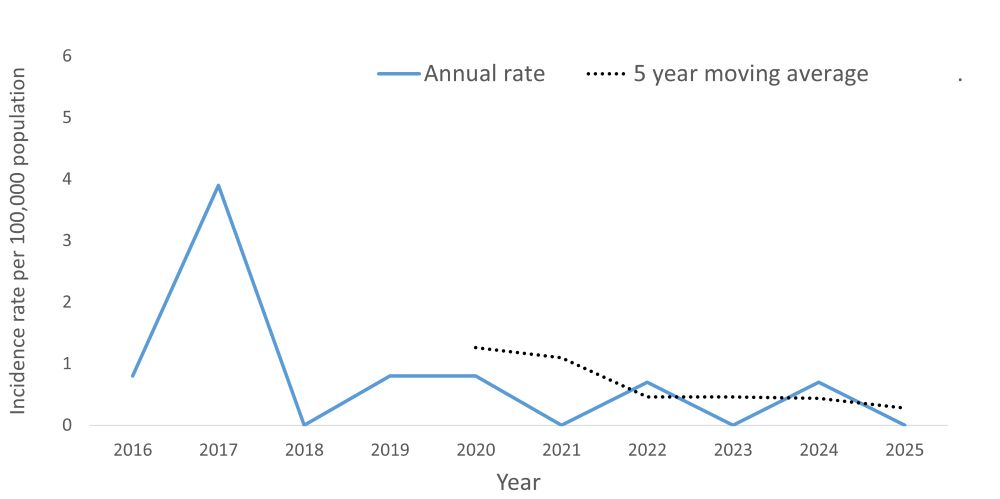
Incidence rate is the number of new cases of disease divided by the number of persons at risk for the disease during a particular time period.
Cases:
0*
Incidence rate per 100,000 in 2025: 0
*Includes confirmed cases in 2025.
Incidence rate per 100,000 of verotoxin producing E. coli including HUS by year
More information about E. coli and HUS
Public Health Agency of Canada:
- Causes of E. coli infection
- Symptoms of E. coli infection
- Risks of E. coli infection
- Treatment of E. coli infection
- Prevention of E. coli infection
- General food safety tips
BC Centre for Disease Control:
Report to the Health Unit within one business day by fax (705-482-0670) or phone at 705-474-1400 or toll free at 1-800-563-2808, ext. 5229 if verotoxin-producing E. coli infection indicator conditions, including Hemolytic Uremic Syndrome (HUS) is suspected or confirmed as per Ontario Regulation 135/18 and amendments under the Health Protection and Promotion Act, R.S.O., c.H.7.
Exclude symptomatic food handlers, healthcare providers, and childcare staff and attendees until they have provided two consecutive negative stool specimens or rectal swabs taken at least 24 hours apart and at least 48 hours after the completion of antibiotic and/or anti-diarrheal therapy medications, if these medications have been used.
Symptomatic household and other contacts are to be excluded as above. Childcare staff and attendees who test positive but don't have symptoms are also to be excluded as above.
Follow the direction of your healthcare provider, public health case manager, or occupational health at your workplace.
Healthcare provider information
Use of antibiotics is not recommended. Treatment of verotoxin-producing Escherichia coli (VTEC) is largely supportive and may require hospital admission.
Infection prevention and control
Routine practices and contact precautions are recommended for pediatric and incontinent or non-adherent adults. Refer to Public Health Ontario: Best Practices for Routine Practices and Additional Precautions for additional information.
For routine culture and PCR information for enteric bacteria from fecal specimens, see Public Health Ontario: Enteric Bacteria (including Salmonella, Shigella, STEC, Plesiomonas, Yersinia, Aeromonas, Vibrio, or Campylobacter) – Culture and PCR.
Public Health Agency of Canada:
BC Centre for Disease Control:
Public Health Ontario:
Contact our Communicable Disease Control (CDC) program at 705-474-1400 or toll free at 1-800-563-2808, ext. 5229, or by email to cdc@healthunit.ca for more information.
Last updated: Aug 2026, by CDC