
- Case counts (2016-2025), population estimates (2016-2023), & population projections (2024-2025): Public Health Ontario.
- Query: Case counts of reportable diseases by public health unit and year. Toronto, ON: Ontario Agency for Health Protection and Promotion; extracted on March 9, 2026.
Hepatitis B
Hepatitis B is an infection that attacks the liver. It is caused by the hepatitis B virus and is transmitted through contact with the blood or other bodily fluids of an infected person, including through sexual contact, sharing needles, or from mother to baby at birth.
An acute infection occurs within the first six months after exposure to the virus. Some people may have a mild illness with few or no symptoms, while others have more serious illness requiring hospitalizations or even resulting in death. Most healthy adults can get rid of the virus on their own without treatment.
Chronic hepatitis B occurs when the acute infection has lasted for more than six months. Hepatitis B can be prevented through vaccination – offered in grade seven and to those at high risk of infection.
Local Information
2025 Statistics
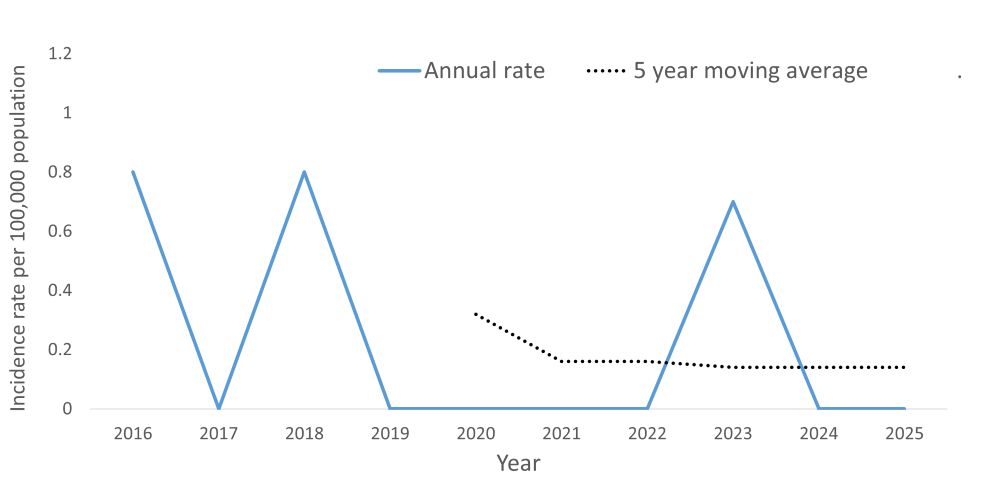
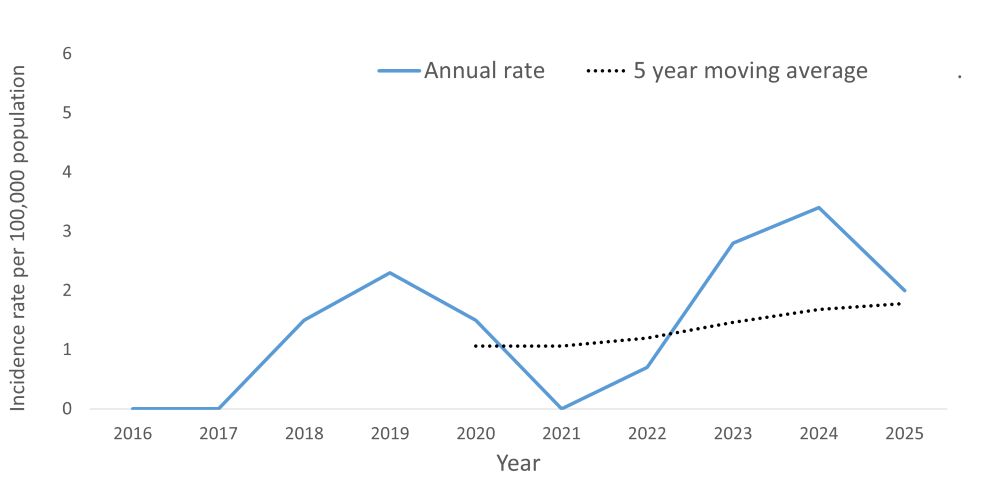
Incidence rate is the number of new cases of disease divided by the number of persons at risk for the disease during a particular time period.
Cases:
0*
Incidence rate per 100,000 in 2025: 0
*Includes confirmed Hepatitis B, acute cases in 2025.
Incidence rate per 100,000 of hepatitis B, acute by year
Cases:
3*
Incidence rate per 100,000 in 2025: 2
*Includes confirmed cases of Hepatitis B, chronic in 2025.
Incidence rate per 100,000 of hepatitis B, chronic by year
More information about hepatitis B
Public Health Agency of Canada:
The Society of Obstetricians and Gynaecologists of Canada:
Liver Canada:
Report to the Health Unit within one business day by fax (705-482-0670) or phone at 705-474-1400 or toll free at 1-800-563-2808, ext. 5229 if hepatitis B is suspected or confirmed as per Ontario Regulation 135/18 and amendments under the Health Protection and Promotion Act, R.S.O., c.H.7.
Should one go to childcare, school, or work if they have hepatitis B?
No exclusion necessary unless too ill to participate in regular activities.
Children with hepatitis B and who have no behavioural or medical risk factors, such as unusually aggressive behaviour (e.g., frequent biting), generalized dermatitis, or a bleeding problem, should be admitted to childcare without restrictions. Children with hepatitis B and these behavioural or medical risk factors should be assessed on an individual basis by the child's physician, in consultation with the childcare staff.*
Follow the direction of your healthcare provider, public health case manager, or occupational health at your workplace.
Note: Exclusion guidelines may differ for healthcare workers.
*American Academy of Pediatrics. [Hepatitis B]. In: Kimberlin DW, Banerjee R, Barnett ED, Lynfield R, Sawyer MH, eds. Red Book: 2024 Report of the Committee on Infectious Disease. American Academy of Pediatrics; 2024 (p. 457).
Hepatitis B is preventable by vaccination. Check your vaccination records or call the Vaccine Preventable Diseases program at 705-474-1400 or toll free at 1-800-563-2808, ext. 5252 to book a vaccination appointment or to obtain additional information.
Healthcare Provider Information
Public Health Ontario:
Canadian Blood Services:
Ministry of Health - Ontario Public Health Standards:
Public Health Agency of Canada:
- Hepatitis B For Health Professionals
- Hepatitis B Vaccines - Canadian Immunization Guide
- Primary Care Management of Hepatitis B - Quick Reference
U.S. Centres for Disease Control and Prevention:
See our Mandatory Blood Testing Act (MBTA) information.
Contact our Communicable Disease Control (CDC) program at 705-474-1400 or toll free at 1-800-563-2808, ext. 5229, or by email at cdc@healthunit.ca for more information.
Last updated: Mar 2026, by CDC