
- Case counts (2016-2025), population estimates (2016-2023), & population projections (2024-2025): Public Health Ontario.
- Query: Case counts of reportable diseases by public health unit and year. Toronto, ON: Ontario Agency for Health Protection and Promotion; extracted on March 9, 2026.
Candida Auris
C. auris
Candida auris (C. auris) is a fungus that is often multidrug resistant that can cause severe illness, particularly in critically ill or immunocompromised patients. C. auris can infect any body part, including the ears, the blood, or a wound. Symptoms of an infection with C. auris are often nonspecific and may include fever, chills, and general malaise, resembling other common infections. As a result, these infections can be difficult to diagnose; they can also be challenging to treat due to resistance to antifungal medications. People can have C. auris on their skin and other body sites without having any symptoms; this is referred to as colonization.
Local information
2025 Statistics
Incidence rate is the number of new cases of disease divided by the number of persons at risk for the disease during a particular time period.
Cases:
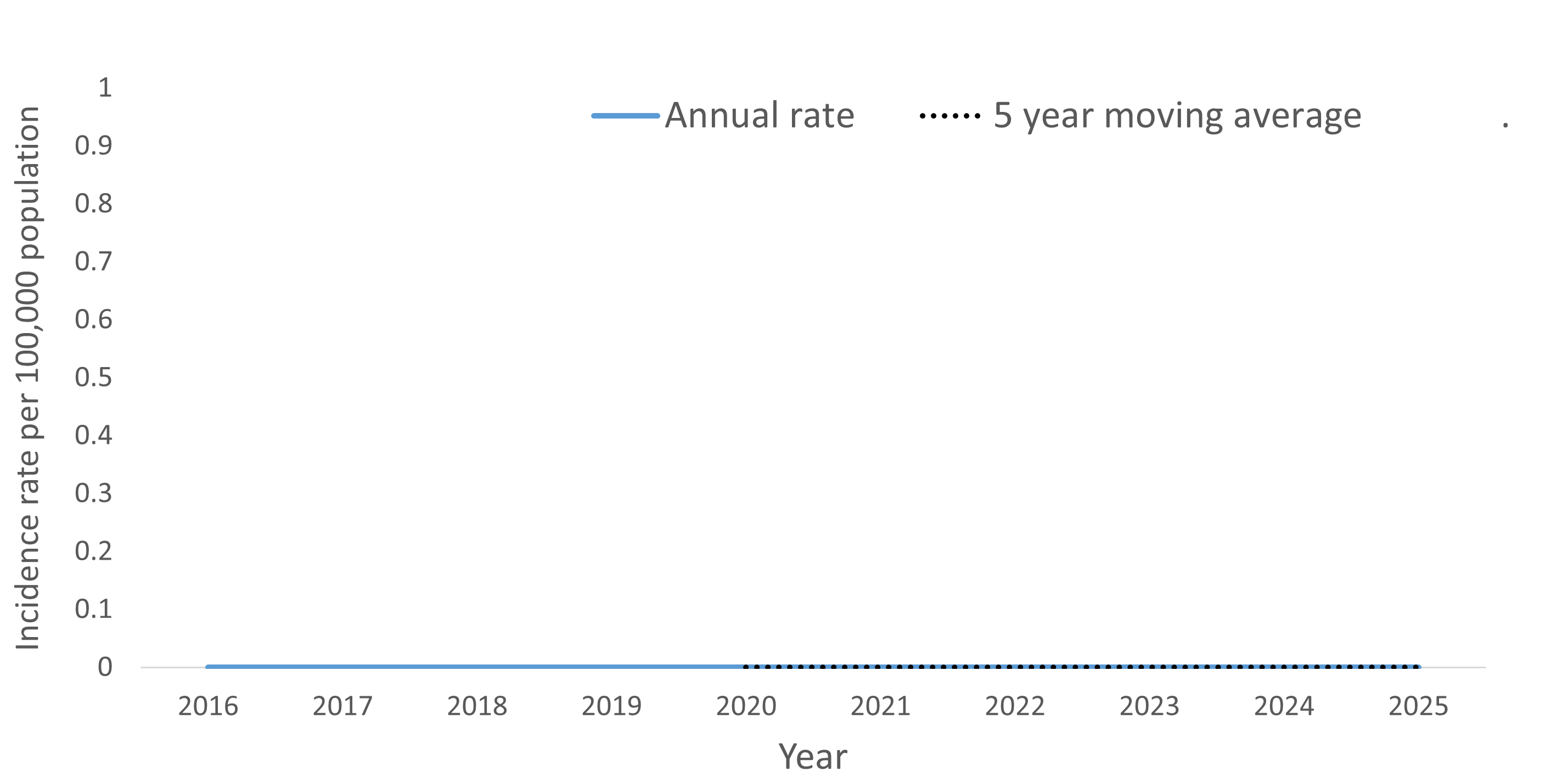
0*
Incidence rate per 100,000 in 2025:
0
*Includes confirmed cases in 2025
Incidence rate per 100,000 of candida auris infection by year
More Information about C. auris
Report to Health Unit within one business day by fax (705-482-0670) or phone at 705-474-1400 or toll free 1-800-563-2808, ext. 5229 if Candida auris is confirmed as per Ontario Regulation 135-18, and amendments under the Health Protection and Promotion Act, R.S.O., c.H.7.
Note: Currently only Candida auris infections are reportable.
Should one go to childcare, school, or work if they have C. auris?
No exclusion necessary unless too ill to participate in regular activities.
Follow the direction of your healthcare provider, public health case manager, or your occupational health at your workplace.
Note: Exclusion guidelines may differ for healthcare workers and those in healthcare settings.
Healthcare provider information
Infection prevention and control
Screening
Refer to Public Health Ontario: ARO Risk-Factor Based Screening Guidance for All Healthcare Settings Screening Checklist for guidance on when and how to screen patients for Candida auris (and other Antibiotic Resistant Organisms) as well as follow-up actions for a positive C. auris screen.
Additional Precautions
Patients identified as colonized or infected with C. auris should be placed into a single (private) room with dedicated toileting facilities not shared with other patients. Staff and visitors entering the room should use both Routine Practices and Contact Precautions (i.e., gown and gloves).
Cleaning and Disinfection
Rooms should be cleaned and disinfected at least daily and upon discharge, following the Provincial Infectious Diseases Advisory Committee’s Best Practices for Environmental Cleaning of rooms for patients on Contact Precautions. Medical equipment should be dedicated to the patient, should not be used on other patients, and should be cleaned and disinfected at least daily and upon discharge.
Refer to Provincial Infectious Diseases Advisory Committee (PIDAC): Interim Guide for Infection Prevention and Control of Candida auris and Public Health Ontario: Management of a Single New Case of Candida auris (C. auris) for additional information.
To ensure that patients and residents with C. auris infection are identified, microbiology labs should be capable of accurately identifying C. auris from appropriate specimens or should forward relevant specimens to Public Health Ontario’s laboratory for definitive identification. See Public Health Ontario: Mycology – Candida auris for details. Appropriate specimens for which identification of C. auris is essential include all candida isolated from sterile site specimens and screening specimens collected from patients identified as high risk for C. auris infection or colonization.
Public Health Agency of Canada:
Public Health Ontario:
Contact our Communicable Disease Control (CDC) program at 705-474-1400 or toll free at 1-800-563-2808, ext. 5229, or by email to cdc@healthunit.ca for more information.
Last updated: Mar 2026, by CDC