Tuberculin Skin Testing Guide

Tuberculosis (TB) infection and confirmed/suspect cases of TB disease are reportable to the Health Unit.

TB disease

TB is an infection with Mycobacterium tuberculosis acquired by inhalation of bacilli-containing droplet nuclei small enough to reach the alveoli. The immune system of some individuals are able to eradicate the bacteria; in others, the bacteria replicate and establish TB infection. A person with TB disease has symptoms, signs, and/or radiographic evidence of infection; disease may be pulmonary, extrapulmonary, or both.

Transmission of M. tuberculosis occurs mostly (with very few exceptions) via droplet nuclei which are inhaled by those who are exposed. For this reason, only those with pulmonary and/or laryngeal TB disease are likely to be contagious.

The probability of transmission varies with bacterial burden, cavitary or upper lung-zone disease on chest radiograph in the source case, laryngeal disease in the source case, exposure of bacilli to sun or UV light, amount and severity of cough in the source case, duration of exposure, proximity to source case, crowding and poor room ventilation, and delays in diagnosis, and/or effective treatment.
  • Include a cough that lasts longer than two weeks that may be productive (blood or phlegm).
  • Fever and night sweats are common but may be absent from the very young and elderly.
  • Additional symptoms of TB disease include anorexia, weight loss, chest pain, and fatigue.

Tuberculosis infection

TB infection is a state of infection with M. tuberculosis without any clinical symptoms. A person with TB infection does not have active disease and is not contagious. TB infection can develop into active disease at any time. Identification and treatment of TB infection can substantially reduce the risk of development of TB disease.

There are two acceptable tests for identification of TB infection: the TST and the Interferon Gamma Release Assay (IGRA). Refer to Chapter 4: Diagnosis of tuberculosis infection of the Canadian Tuberculosis Standards, 8th edition, for more information.

See also, the TB infection fact sheet.

The goal of testing for TB infection is to identify individuals who are at increased risk for the development of  TB disease, and therefore, would benefit from treatment of TB infection. Screening for TB infection should be undertaken only when there is a commitment to treatment or monitoring, should the test results be positive.

Testing for TB infection is performed among individuals at increased risk of TB exposure, those who regularly interact with vulnerable populations, or who may be at increased risk of adverse outcomes should TB disease develop. The TST is the preferred test when serial testing is planned to assess the risk of new infection. This includes serial testing of healthcare workers or other populations with potential for ongoing exposure.

See International TB Rates by Country and the WHO Global Lists of High Burden Countries for TB, p. 13.

See additional screening recommendations for LTCH/RH residents and employees/volunteers.

Tuberculin Skin Test (TST)

The TST consists of the intradermal injection of a small amount of purified protein derivative (PPD), which is derived from a nonspecific mixture of antigens from M. tuberculosis bacteria. In a person who has cell-mediated immunity to these tuberculin antigens, a delayed hypersensitivity reaction will occur within 48 to 72 hours. The reaction will cause localized swelling and will manifest as an induration of the skin at the injection site.

Note: The use of TSTs or IGRAs to exclude the diagnosis of TB disease is not recommended.

A two-step TST is useful for the initial skin testing of adults who are going to be re-tested periodically (e.g., healthcare workers), due to an elevated risk of exposure. These persons should undergo a two-step TST prior to any exposure to account for the booster effect. This is because the initial TST may elicit an immune response in persons with remote TB infection or prior Bacille Calmette-Guerin (BCG) vaccination.

This “boosted” immune response results in a greater response if a second TST is administered anytime from a week to more than a year later. The two- step protocol needs to be performed and documented ONCE. Any subsequent TST should be a one-step, regardless of how long it has been since the last TST.

A second test should be performed one to four weeks after the first test, using the same materials and techniques to administer and read the TST.

The Health Unit offers TSTs to specific populations. See our TB Testing page for more information and contact the Vaccine Preventable Diseases (VPD) program at 705-474-1400 or toll free 1-800-563-2808, ext. 5252 or by email at vpd@healthunit.ca.

Indications

Do not give a TST to someone who has:

  • Severe blistering TST reactions in the past
  • Extensive burns or eczema present over TST sites
  • A current major viral infection (e.g., measles, mumps, varicella)
  • Documented TB disease or a well-documented history of adequate treatment for TB infection or disease in the past
  • Received live virus immunization within the past four weeks
  • Known hypersensitivity to Tubersol® PPD-Standard or to any components of the formulation or container

Vaccination with live viruses may interfere with TST reactions. For persons scheduled to receive a TST, testing should be done as follows:

  • Either on the same day as vaccination with live-virus vaccine
  • Or at least one month after the administration of the live-virus vaccine

Note: If the opportunity to perform TST might be missed, TST should not be delayed for live virus vaccines.

A TST can be given to those who:

  • Are pregnant or breastfeeding
  • Have a history of receiving a BCG vaccine
  • Have a previously positive TST
  • Are taking low doses of systemic corticosteroids (<15mg prednisone or equivalent daily)
  • Have a common cold
  • Have had an immunization the same day (TST should be administered at a different site)
  • Were immunized within the previous four weeks with vaccines other than live virus vaccines

Step 1. Administering a TST

  • Use inner aspect of forearm, 10 cm (4 inches) below elbow, preferably on the non-dominant arm. If neither forearm is suitable, use the outside of the forearm or the upper arm
  • Avoid areas with abrasions, swelling, visible veins, lesions, rash, eczema, burns, or tattoos
  • Clean area with alcohol swab and let air dry
  • Do not use EMLA® or other local anesthetic cream on area being tested

  • 5 tuberculin units of Tubersol® PPD-Standard is recommended in Canada
  • Check expiry date and ensure vials are labelled with dates when opened
  • Use a 0.6 to 1.3 cm (1/4 -1/2 inch), 26- or 27-gauge needle with a disposable plastic tuberculin syringe
  • Draw up solution just prior to injecting it. Do not preload syringes
  • Withdraw a little more than 0.1 mL of tuberculin solution from vial using aseptic technique.
  • Expel 1 drop and ensure that 0.1 mL remains in syringe
  • Tubersol® PPD-Standard should be stored between 2-to-8-degrees Celsius except when doses are actually being withdrawn from the vial

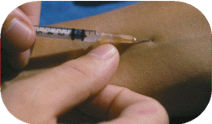
  • Hold skin taut. Position the bevel of the needle facing up. Insert needle intradermally at a 5-to-15-degree angle to the skin, without aspirating. The tip of the needle will be visible just below the surface of the skin. Insert the needle until the entire bevel is covered
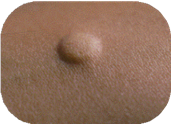
  • Slowly inject 5 tuberculin units (0.1mL) of Tubersol® PPD-Standard
  • A 6 to 10 mm wheal (discrete, pale elevation of the skin) should appear
  • The size of the wheal is not completely reliable, but if a lot of liquid runs out and there is no wheal, then repeat the injection on the opposite forearm or 5 cm away from the initial injection site on the same forearm
  • A drop of blood is normal. Use a cotton ball or gauze to remove blood but do not push on or massage the area

  • ·        Do not cover with bandage
  •     Do not scratch site
  •     Perform all normal activities, including showering and bathing, but do not scrub area
  •     Wheal often disappears within 15 minutes
  •     Client must return 48-72 hours after administration for reading by a trained healthcare professional

  • Date and time of injection
  • Tuberculin dose, manufacturer, lot number, and expiry date
  • Site of injection
  • Person administering the TST

Monitor client for 15 minutes post-injection in case of allergic reaction. Although very rare, be prepared to manage anaphylaxis.

Step 2: Reading results

A healthcare professional trained to read TSTs should read the test within 48 to 72 hours after administration.

If the TST cannot be read within 48 to 72 hours after administration, it should be repeated at a location far enough from the previous test that the reactions do not overlap. No minimum wait time is required before repeat testing.

  • Support the forearm on a firm surface and flex slightly at the elbow.
  • Look for induration (a hard, dense, raised formation). Note that induration is not always visible.

  • Use fingertips to check if induration is present.

  • To mark the border of the induration, move the tip of a pen at a 45-degree angle laterally toward the site of the injection.
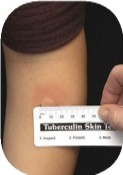
  • The tip will stop at the edge of the induration if it is present.
  • Repeat this on the opposite side of the induration.

  • Use a caliper (or flexible ruler) to measure the distance between the pen marks at the widest transverse diameter (at a right angle to the long axis of the forearm)
  • Measure induration in millimetres (mm). Record no induration "0 mm". Avoid words such as "positive", "negative", "reactive", or "non-reactive"
  • If the measurement falls between demarcations on the ruler, record the lower measurement. Do not round off the diameter of the induration to the nearest 5 mm
  • Do NOT measure erythema (redness). Redness does not indicate TB infection and is not a contraindication to future TSTs

  • Date induration is read
  • Measurement of the induration, if any, in millimetres (mm)
  • Record any adverse reactions (e.g., blistering)
  • Name of the individual reading the test

Step 3: Interpreting results

Some persons may react to the TST even though they are not infected with M. tuberculosis. The causes of these false-positive reactions may include, but are not limited to:

  • Previous TB vaccination with the BCG vaccine (consider IGRA blood tests for those that have had a previous BCG vaccination)
  • Infection with non-tuberculous mycobacteria
  • Incorrect measurement or interpretation of reaction
  • Incorrect antigen used

Some individuals that are infected with M. tuberculosis may not react to the TST. Reasons for this false-negative reaction may include, but are not limited to:

  • Anergy (absence of the normal immune response to a particular antigen)
  • Recent TB infection (it takes 3 to 8 weeks after exposure for a TST to become positive)
  • Very young age (younger than 6 months)
  • A weakened immune system due to a Human Immunodeficiency Virus (HIV) infection
  • TB disease (especially if advanced)
  • Recent live-virus vaccination (e.g., measles, mumps, rubella, varicella, or yellow fever)
  • Incorrect method of administering
  • Incorrect measuring or interpretation of TST reaction

Interpreting a TST result primarily depends on the clinical context. There are multiple dimensions to consider when faced with a positive or negative TST to help decide whether someone is at risk of developing TB disease. These include the pretest probability for the person being truly infected with TB, the individual risk for developing TB disease (i.e., medical conditions or recent exposure), and the ability of the test to identify persons at risk of TB disease.

Refer to Chapter 4: Diagnosis of Tuberculosis Infection of Canadian Tuberculosis Standards, 8th edition for more information.

The online TST/IGRA Interpreter interactive algorithm incorporates all three dimensions discussed above.

Table 1: Interpretation of TST results

TST result Situation in which a reaction is considered positive
<5 mm In general, this is considered negative.
≥5 mm
  • Known recent (<2 years) contact with a person with infectious TB disease
  • Fibronodular disease on chest x-ray (evidence of healed, untreated TB)
  • Prior to organ transplantation and receipt of immunosuppressive therapy
  • Prior to receipt of biologic drugs, such as tumor necrosis factor alpha inhibitors, or disease-modifying antirheumatic drugs
  • Prior to receipt of other immunosuppressive drugs, such as corticosteroids (equivalent of >15mg per day of prednisone for at least one month)
  • Stage 4 or 5 chronic kidney disease (with or without dialysis)
  • People living with HIV (Human Immunodeficiency Virus)
≥10 mm
  • Malnutrition (<90% of ideal body weight)
  • Diabetes (controlled or uncontrolled)
  • Recent (<2 years) conversion of TST from negative to positive
  • Current tobacco smoker (any amount)
  • Daily consumption of >3 alcoholic drinks
  • Silicosis 
  • Hematologic malignancies (lymphomas and leukemia) and certain carcinomas (such as cancers of head, neck, lung, and/or gastrointestinal tract)
  • Any population considered at low risk of disease
  Note: a negative TST or IGRA is expected in up to 30% of children with TB and should not be used to exclude diagnosis. Consider consultation with an infectious disease specialist if there are concerns regarding TB in this population.

Risk of TB disease

The following table provides estimates of disease risk for various populations.

Very high risk
  • People living with HIV (Human Immunodeficiency Virus)
  • Child or adolescent (<18 years) TB contact
  • Adult (>18 years) TB contact
  • Silicosis
High risk
  • Stage 4 or 5 chronic kidney disease with or without dialysis
  • Transplant recipients (solid organ or hematopoietic)
  • Fibronodular disease
  • Receiving immunosuppressive drugs (e.g., tumor necrosis factor α inhibitors or steroids)*
  • Cancer (lung, sarcoma, leukemia, lymphoma, or gastrointestinal)
Moderate risk
  • Granuloma on chest x-ray
  • Diabetes
  • Heavy alcohol use (at least three drinks/day)
  • Heavy tobacco cigarette smoker (at least one pack/day)
Low risk
  • General (adult) population with no known risk factor
  • Persons with a positive two-step TST booster and no known risk factor
 

*Risk does not appear significantly elevated with low-dose steroids (i.e., prednisone), but elevated with moderate or high dose (low dose, ≤9 mg/day; medium dose, 10-19 mg/day; and high dose, ≥20mg/day).

Refer to Chapter 4: Diagnosis of Tuberculosis infection of the Canadian Tuberculosis Standards, 8th edition, for more information.

Step 4: Managing a positive result

  • There are online tools that can help support decisions in interpreting TST results among different populations that consider many of the factors involved in interpreting TST results. The online TST/IGRA Interpreter interactive algorithm should be used to support decision making with respect to TST interpretation and offering treatment for TB infection (latent).
  • Investigate further to rule out a false positive. Interferon-gamma release assay (IGRA) may be used to increase specificity, when the likelihood of TB infection is low and/or the risk of a false positive result due to Bacille Calmette-Guérin (BCG) is high.
  • If a TST is considered positive, the individual should be referred for medical evaluation to rule out TB disease prior to initiating tuberculosis infection preventive treatment (TPT).
  • There is no clinical utility in performing a TST in the future if the test was properly performed, read, and interpreted.

  • Assess signs and symptoms suggestive of possible TB disease, assess patient risk factors (Table 2), and order chest radiography (x-ray).
  • In the presence of symptoms or abnormal chest x-ray, collect three sputum samples (can be done on the same day), at least one hour apart for acid-fast bacilli (AFB) smear and culture.
  • Treatment for TB infection should be individualized and based on the risk of prior TB exposure and risk of reactivation. TB disease must carefully be ruled out prior to starting TB infection treatment.
  • If TB disease is ruled out by the medical evaluation, a shared decision between the healthcare provider and patient whether to initiate treatment should be made. Initiation of treatment for TB infection is recommended for those who are at increased risk for the development of tuberculosis disease and therefore would benefit from tuberculosis preventative treatment.

TB infection and confirmed/suspect cases of TB are reportable to the Communicable Disease Control (CDC) Program.

Summary of recommended treatment regimens for TB infection

Resources and References

Public Health Agency of Canada

Canadian Journal of Respiratory, Critical Care, and Sleep Medicine

Sanofi Pasteur Limited


  1. David L. Heymann, Control of Communicable Diseases Manual, 21st ed., American Public Health Association, Washington, DC. 2022, p.666-677

Contact Us

North Bay Parry Sound District Health Unit

North Bay
345 Oak Street West

Parry Sound
90 Bowes St, 2nd Floor, Suite 201

Phone 705-474-1400
Toll Free 1-800-563-2808
contact@healthunit.ca