
- Case counts (2016-2025), population estimates (2016-2023), & population projections (2024-2025): Public Health Ontario.
- Query: Case counts of reportable diseases by public health unit and year. Toronto, ON: Ontario Agency for Health Protection and Promotion; extracted on March 9, 2026.
Q Fever
Query fever
Q Fever is an infectious disease caused by the bacteria Coxiella burnetii. It can be found in animals such as sheep, cattle, goats, cats, and dogs.
It is spread to humans by inhaling dust contaminated by infected animals’ urine, milk, stool, and other fluids or by direct contact with these contaminated items.
Many people do not develop symptoms when they are infected. Common symptoms, if present, resemble a serious case of the flu with high fever, chills, and sweating. Sometimes people develop liver and heart disease. Some people may develop a chronic Q fever that is serious and can be fatal if not treated correctly.
Local Information
2025 Statistics
Incidence rate is the number of new cases of disease divided by the number of persons at risk for the disease a particular time period.
Cases:
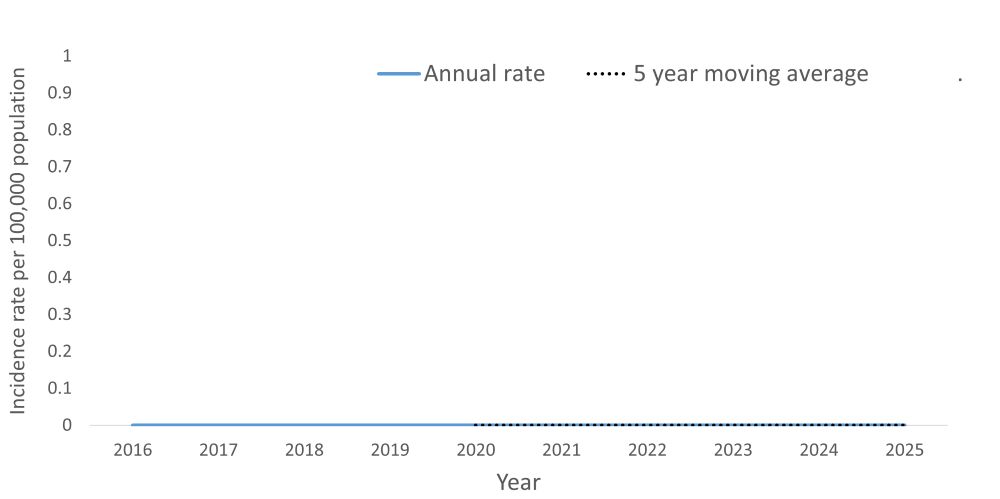
0*
Incidence rate per 100,000 in 2025: 0
*Indicates confirmed cases in 2025.
Incidence rate per 100,000 of Q fever by year
More information about Q fever
For workers who are in contact with animals, animal products, or animal waste: Ministry of Health: Cosiella burnetti in small ruminants and Q fever in humans and Canadian Centre for Occupational Health and Safety: Q Fever.
Report to the Health Unit immediately by fax (705-482-0670) and phone at 705-474-1400 or toll free at 1-800-563-2808, ext. 5229 if Q fever is suspected or confirmed as per Ontario Regulation 135/18 and amendments under the Health Protection and Promotion Act, R.S.O., c.H.7.
After hours, weekends, and holidays, call 705-474-1400 then press 0 to speak with the Answering Service. The on-call CDC Public Health Nurse will get back to you as soon as possible.
Should one go to childcare, school, or work if they have Q Fever?
No exclusion necessary unless too ill to participate in regular activities.
Healthcare provider information
There are no vaccines licensed for people in Canada. Canadian veterinarians may have access to a vaccine licensed for use in cattle, sheep, and goats in Europe through direct application to the distributor for appropriate cases.
Treatment is under the direction of the attending health care provider – acute cases generally require treatment with antibiotics.
Refer to the Pathogen Safety Data Sheet – Infectious Substances – Coxiella burnetii for First Aid/Treatment information.
Infection prevention and control
Routine practices are recommended for care of individuals infected with Q fever.
Public Health Ontario:
Ministry of Health:
Contact our Communicable Disease Control (CDC) program at 705-474-1400 or toll free at 1-800-563-2808, ext. 5229, or by email to cdc@healthunit.ca for more information.
Last updated: June 2026, by CDC