
- Case counts (2016-2025), population estimates (2016-2023), & population projections (2024-2025): Public Health Ontario.
- Query: Case counts of reportable diseases by public health unit and year. Toronto, ON: Ontario Agency for Health Protection and Promotion; extracted on March 9, 2026.
Rubella and Congenital Rubella Syndrome
German measles and CRS
Rubella, also known as German Measles, is a highly contagious disease caused by the rubella virus.
It can be spread through direct contact (e.g., kissing an infected person, sharing food or drinks, or touching objects contaminated with the virus) or through the air when an infected person coughs, sneezes, or talks.
A pregnant individual and their unborn baby are most at risk of serious difficulties if they become infected with rubella.
A pregnant individual infected with rubella has a 90% chance of transmitting the disease to their unborn baby. However, it is rare for a person who has been immunized to become infected with rubella. If the baby becomes infected, they can be born with congenital rubella syndrome (CRS), which can cause lifelong damage to the baby’s health.
The baby can also spread the infection through urine, a runny nose, sneezing, and/or coughing. There is no treatment for CRS, but rubella is preventable by vaccination.
Local Information
2025 Statistics
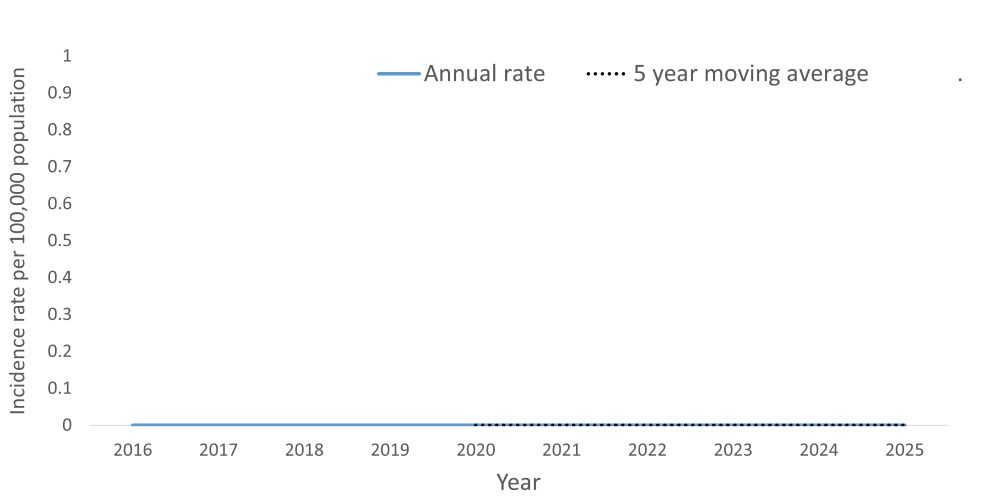
Incidence rate is the number of new cases of disease divided by the number of persons at risk for the disease during a particular time period.
Cases:
0*
Incidence rate per 100,000 in 2025: 0
*Includes confirmed cases in 2025.
Incidence rate per 100,000 of rubella by year
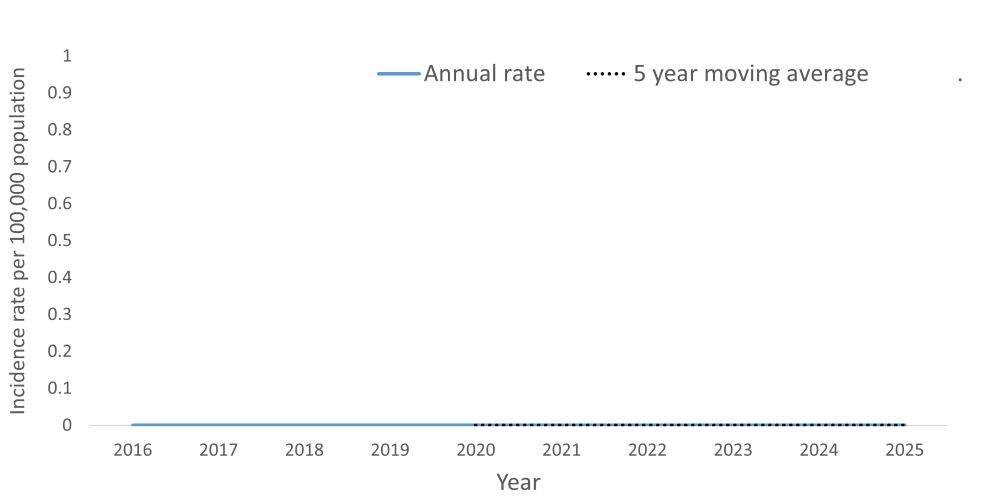
Cases:
0*
Incidence rate per 100,000 in 2025: 0
*Includes confirmed cases in 2025.
Incidence rate per 100,000 of congenital rubella syndrome by year
More information about rubella and congenital rubella syndrome
Public Health Agency of Canada:
- Causes of rubella
- Symptoms of rubella
- Risks of rubella
- Treatment of rubella
- Prevention of rubella
- Surveillance of rubella
Ministry of Health:
Caring for Kids, Canadian Paediatric Society:
Report to the Health Unit within one business day by fax (705-482-0670) or phone at 705-474-1400 or toll free at 1-800-563-2808, ext. 5229 if rubella or congenital rubella syndrome is suspected or confirmed as per Ontario Regulation 135/18 and amendments under the Health Protection and Promotion Act, R.S.O., c.H.7.
Should one go to childcare, school, or work if they have rubella?
For rubella, exclude from work, school, childcare, and other activities for seven days after the rash started. Avoid contact with pregnant individuals for seven days after the rash started.
For congenital rubella syndrome, infants should be isolated from non-immune pregnant individuals, infants, and children, and should be considered contagious until there are two sets of negative tests.
Follow the direction of your healthcare provider, public health case manager, or occupational health at your workplace.
Rubella is preventable by vaccination. Check your vaccination records or call the Vaccine Preventable Diseases program at 705-474-1400 or toll free at 1-800-563-2808, ext. 5252 to book a vaccination appointment or to obtain additional information.
Healthcare provider information
Rubella is preventable by vaccination. Refer to the Publicly Funded Immunization Schedules for Ontario for information on routine and high-risk immunization programs and schedules.
See also the Rubella vaccines chapter of the Canadian Immunization Guide for detailed Rubella vaccine information.
There is no specific treatment for rubella infection.
There is no specific treatment for congenital rubella except for symptomatic and supportive care.
Infection prevention and control
In addition to routine practices, droplet precautions (eye protection and medical mask) are recommended for seven days after the onset of the rash.
For congenital rubella, in addition to routine practices, droplet and contact precautions (eye protection, medical mask, gloves and gown) for one year after birth are recommended, unless two sets of tests after three months of age are negative. Public Health Ontario: Clinical Syndromes/Conditions with Required Level of Precautions.
Public Health Ontario:
Because of the implications of acute rubella infection in a pregnant person and the potential for a false positive IgM result, avidity testing of Rubella IgG antibodies is recommended for pregnant people with a positive IgM result when there is no change in observed rubella IgG levels.
Post-exposure prophylaxis (PEP)
Post-exposure vaccination with MMR vaccine or human immunoglobulin (Ig) does not prevent or alter the clinical severity of rubella after exposure. MMR vaccine should be given to susceptible individuals because exposure may not result in infection, and the MMR vaccine will induce protection against subsequent exposures.
Canadian Immunization Guide:
A contact of a rubella case is any susceptible person who has had close contact with the case during the period of communicability. Confirm rubella susceptibility status for pregnant contacts and where negative, perform serology to determine if infected. Routine use of immunoglobulin for susceptible people exposed to rubella early in pregnancy is not recommended.
Ministry of Health:
Public Health Ontario:
Public Health Agency of Canada:
Contact our Communicable Disease Control (CDC) program at 705-474-1400 or toll free at 1-800-563-2808, ext. 5229, or by email to cdc@healthunit.ca for more information.
Last updated: June 2026, by CDC