
- Case counts (2016-2025), population estimates (2016-2023), & population projections (2024-2025): Public Health Ontario.
- Query: Case counts of reportable diseases by public health unit and year. Toronto, ON: Ontario Agency for Health Protection and Promotion; extracted on March 9, 2026.
Diphtheria
Diphtheria is a contagious disease that is caused by bacteria. Anyone who has not been immunized can get diphtheria. Diphtheria can be very serious, especially for infants and very young children. It was once one of the most common causes of death in Canadian children under the age of five. Thanks to immunization, in the last 20 years, less than five cases of diphtheria are reported each year in Canada.
Local Information
2025 Statistics
Incidence rate is the number of new cases of disease divided by the number of persons at risk for the disease during a particular time period.
Cases:
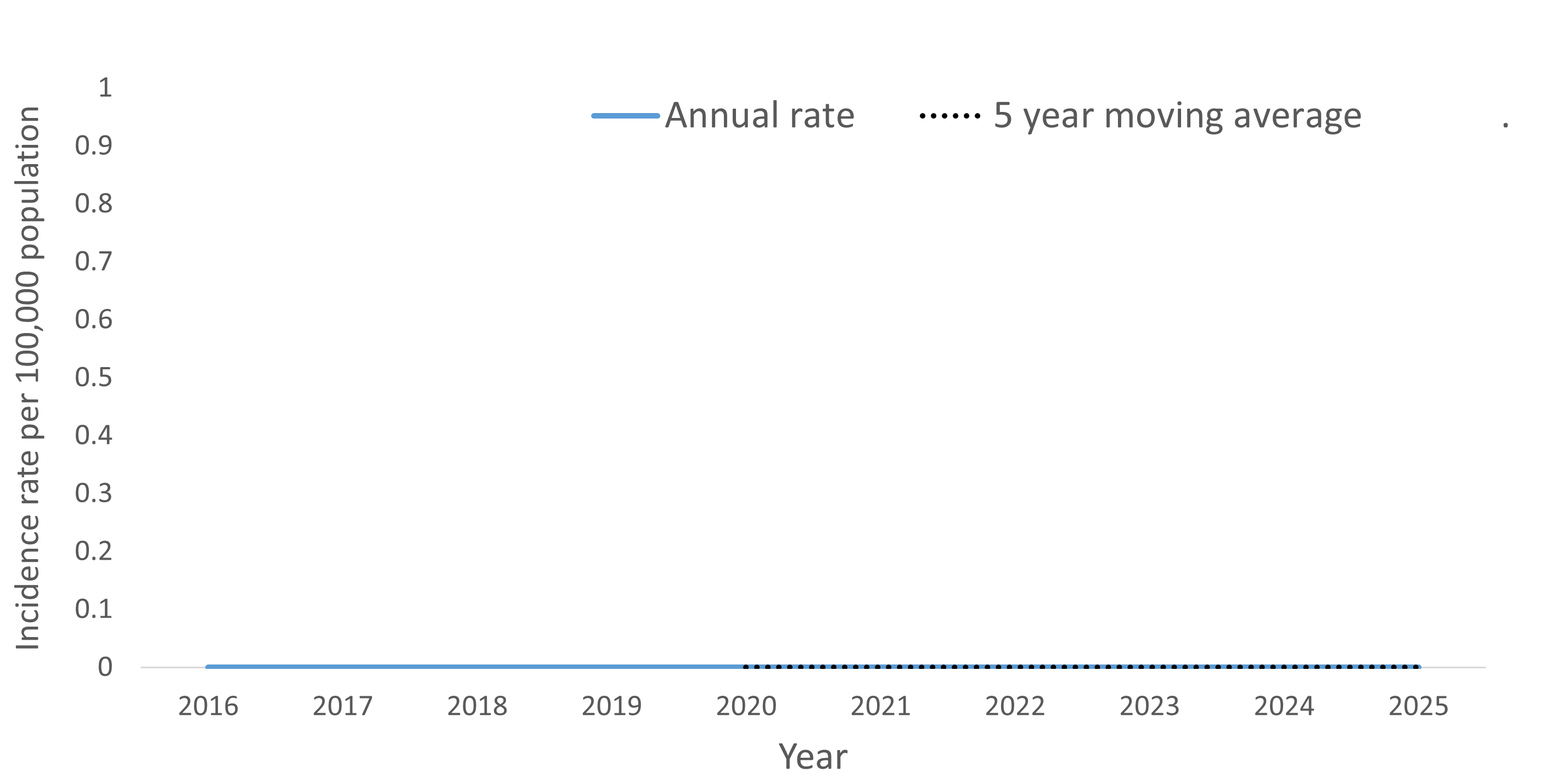
0*
Incidence rate per 100,000 in 2025: 0
*Includes confirmed cases in 2025.
Incidence rate per 100,000 of diphtheria by year
More information about diphtheria
Public Health Agency of Canada:
Ministry of Health:
Report to the Health Unit immediately by fax (705-482-0670) and phone at 705-474-1400 or toll free at 1-800-563-2808, ext. 5229 if diphtheria is suspected or confirmed as per Ontario Regulation 135/18 and amendments under the Health Protection and Promotion Act, R.S.O., c.H.7.
After hours, weekends, and holidays, call 705-474-1400 then press 0 to speak with the Answering Service. The on-call CDC Public Health Nurse will get back to you as soon as possible.
Should one go to childcare, school, or work if they have diphtheria?
Contact the Health Unit. Exclusion is required, but the length is assessed on an individual case basis.
Follow the direction of your healthcare provider, public health case manager, or occupational health at your workplace.
Diphtheria is preventable by vaccination. Check your vaccination records or call the Vaccine Preventable Diseases program at 705-474-1400 or toll free at 1-800-563-2808, ext. 5377 to book a vaccination appointment or to obtain additional information.
Healthcare provider information
In Ontario, individuals are immunized with diphtheria toxoid-containing vaccines beginning in infancy. Refer to the Publicly Funded Immunization Schedules for Ontario for information on eligibility and timing of publicly funded vaccines. Refer to Diphtheria toxoid: Canadian Immunization Guide for detailed information on the diphtheria toxoid vaccine.
Immunize Canada also has resources on diphtheria immunization for the public and healthcare professionals.
Medical treatment should be provided immediately without waiting for laboratory confirmation. Antitoxin should be administered as soon as possible to be effective. Refer to the Diphtheria Guide for Health Care Professionals for instructions on how to access Diphtheria antitoxin.
Antibiotic treatment should also be provided to eliminate the organism and to prevent transmission. It is not a substitute for antitoxin. Refer to the Infectious Diseases Protocol, Appendix 1: Case Definitions and Disease-Specific Information, Disease: Diphtheria for additional information on treatment of cases.
Infection prevention and control
Hospitalized confirmed or suspect cases and carriers of toxigenic Corynebacterium species, should be cared for as follows:
- Pharyngeal diphtheria: In addition to routine practices, droplet precautions should be in place until two cultures from both the nose and throat collected at least 24 hours apart and at least 24 hours after completing antibiotic treatment are negative. Where culture is impractical, precautions may end after 14 days of appropriate antibiotic therapy.
- Cutaneous diphtheria: In addition to routine practices, contact precautions until two cultures of skin lesions collected at least 24 hours apart and at least 24 hours after completing antibiotic treatment are negative.
- Non-hospitalized carriers of toxigenic Corynebacterium species:
- Exclude from the workplace or school until two negative cultures (nasal and throat swabs) are obtained at least 24 hours after completion of antibiotics.
- Minimize contact with other persons in the household and practice routine and droplet precautions.
The diagnosis of diphtheria is made by the isolation of toxigenic Corynebacterium diphtheriae from an appropriate clinical specimen. Although rare, other toxigenic Corynebacterium species (Corynebacterium ulcerans or Corynebacterium pseudotuberculosis) may cause clinical diphtheria.
Obtain swabs for culture from inflamed areas of the throat, nose and nasopharynx in symptomatic patients. If present, membranous material should also be submitted.
For detection of asymptomatic carriers, nasopharyngeal and throat swabs should be collected. Two or more specimens will increase the chance of detection of the organism.
Clinical specimens must be obtained prior to medical treatment and the administration of diphtheria antitoxin. Clinical specimens should be transported to Public Health Ontario Laboratories for testing. Refer to Diphtheria – Culture, Reference Isolates Identification Confirmation & Toxin Production Confirmation for additional information.
Testing for Diphtheria is not done for immunity/acute diagnosis/pre-vaccination screening and is only available for the rare event of an adverse reaction to Diphtheria vaccine or the possibility of humoral immunodeficiency in the patient. Refer to Diphtheria – Serology for additional information.
Post-exposure prophylaxis (PEP)
PEP for contacts exposed to toxigenic Corynebacterium species (Corynebacterium diphtheriae or Corynebacterium ulcerans).
Diphtheria toxoid-containing vaccine:
- Close contacts (e.g., household, classroom) of a diphtheria case with exposure in the 10 days prior to the onset of symptoms and current close contacts* of asymptomatic carriers should receive an immediate dose of diphtheria toxoid-containing vaccine as appropriate for age unless
- the contact is known to have received at least four doses if the series was started in infancy, or three doses if started on or after seven years of age and received the last dose of diphtheria toxoid-containing vaccine in the last five years.
- Unimmunized or incompletely immunized contacts should receive an immediate dose of diphtheria toxoid-containing vaccine and complete the primary series.
- Refer to Diphtheria toxoid: Canadian Immunization Guide for detailed information on the diphtheria toxoid vaccine.
Antibiotic chemoprophylaxis:
- Is to be given to all close contacts regardless of immunization status, after laboratory specimens have been collected and regardless of culture result.
- Refer to Infectious Diseases Protocol, Appendix 1: Case Definitions and Disease-Specific Information, Disease: Diphtheria for additional information on chemoprophylaxis for contacts.
Diphtheria antitoxin:
- Is not recommended for prophylaxis of immunized or unimmunized close contacts of diphtheria cases.
For contacts proven to be carriers, two follow-up cultures should be obtained at least 24 hours apart and at least 24 hours after completion of antibiotic therapy. If repeat cultures are positive, an additional 10-day course of treatment should be given, based on susceptibility results.
PEP for close contacts who are healthcare workers, attend school or whose occupations involve food handling, close contact with children under seven years of age or known unimmunized persons.
- Exclude, swab their nose and throat and start chemoprophylaxis, regardless of immunization status.
- If the culture results are negative, they may return to work or school while completing the course of antibiotics.
- In situations where the initial culture is positive, they should remain excluded until chemoprophylaxis is complete and follow-up cultures from the nose and throat (and skin lesions, if appropriate) taken at least 24 hours after the completion of antibiotics, are negative.
*Current close contacts of asymptomatic carriers should be identified, unless there is a suspected time of acquisition, in which case all close contacts since that time should be identified.
Public Health Agency of Canada:
Contact our Communicable Disease Control (CDC) program at 705-474-1400 or toll free at 1-800-563-2808, ext. 5229, or by email to cdc@healthunit.ca for more information.
Last updated: Feb 2026, by CDC