
- Case counts (2016-2025), population estimates (2016-2023), & population projections (2024-2025): Public Health Ontario.
- Query: Case counts of reportable diseases by public health unit and year. Toronto, ON: Ontario Agency for Health Protection and Promotion; extracted on March 9, 2026.
Carbapenemase Producing Enterobacteriaceae
CPE
Enterobacteriaceae are a family of bacteria, many of which live naturally in our bowels. Carbapenemase-producing enterobacteriaceae (CPE) produce carbapenemase enzymes that can break down many types of antibiotics, making the bacteria very resistant and hard to treat.
Local Information
2025 Statistics
Incidence rate is the number of new cases of disease divided by the number of persons at risk for the disease during a particular time period.
Cases:
2*
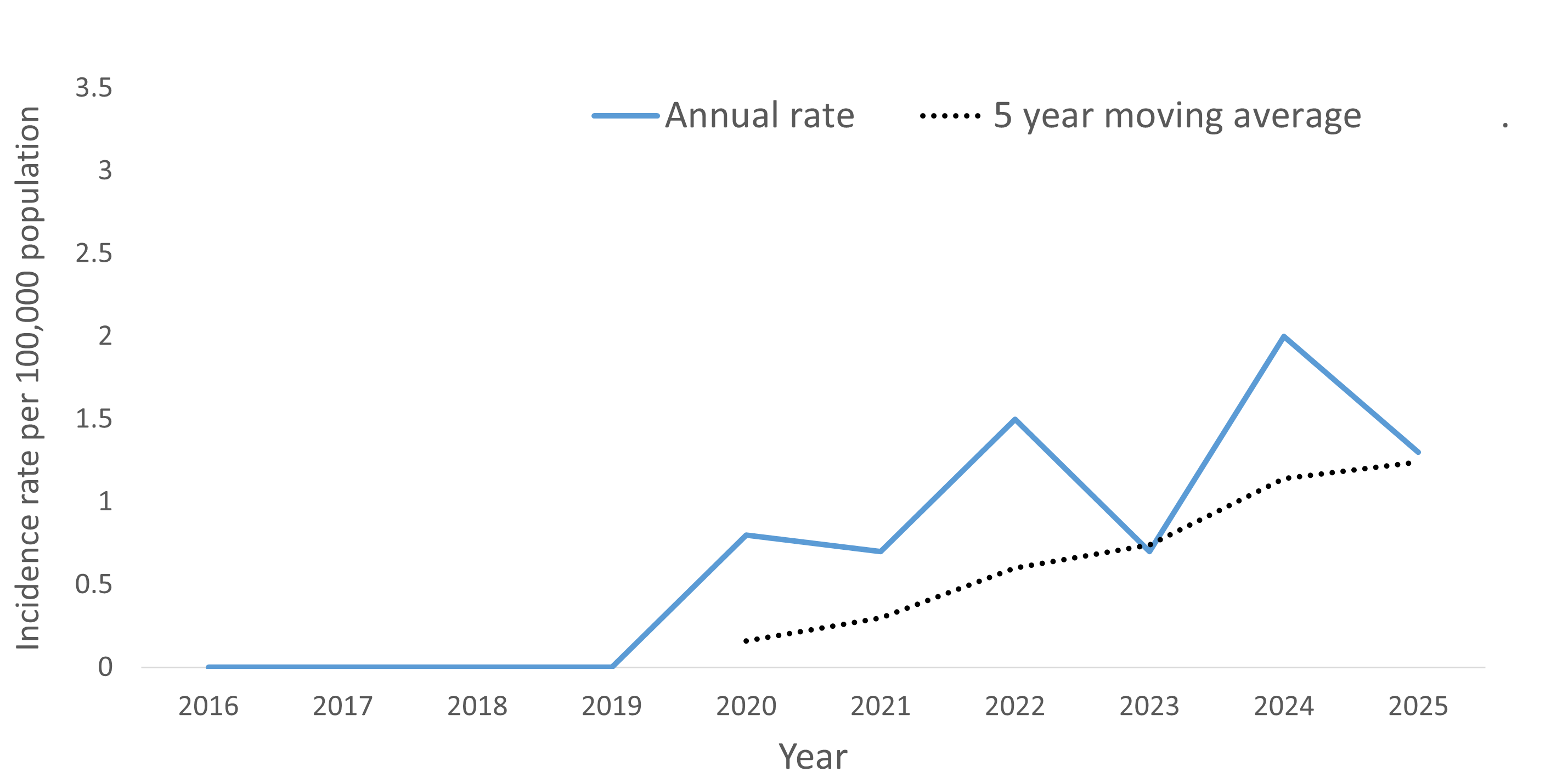
Incidence rate per 100,000 in 2025: 1.3
*Includes confirmed cases in 2025.
Incidence rate per 100,000 of carbapenemase-producing enterobacteriaceae (CPE) by year
Report to the Health Unit within one next business day by fax (705-482-0670) or phone at 705-474-1400 or toll free at 1-800-563-2808, ext. 5229 if CPE is suspected or confirmed as per Ontario Regulation 135/18 and amendments under the Health Protection and Promotion Act, R.S.O., c.H.7.
Should one go to childcare, school, or work if they have CPE?
No exclusion necessary unless too ill to participate in regular activities.
Follow the direction of your healthcare provider or your occupational health at your workplace.
Note: Exclusion guidelines may differ for healthcare workers.
Healthcare provider information
Infection prevention and control
Screening
All health care facilities should institute a screening program and targeted surveillance for CPE in order to implement infection prevention and control measures as early as possible to reduce the risk of transmission to others. Public Health Ontario’s Antibiotic Resistant Organism (ARO) Risk Factor-Based Screening Guidance for All Health Care Settings checklist can be used or adapted by any health care setting as a screening tool for all AROs.
Additional precautions
Individuals may either be colonized (the microorganism is present and growing in or on a body without tissue invasion, cellular injury or symptoms) or infected (the entry and multiplication of an infectious agent in the tissues of the host) with CPE. Contact precautions should be initiated for individuals who are either colonized or infected, including appropriate placement (single/private room preferred), and:
- For patients in acute care - wearing gloves for all activities in the individual’s room or bed space and wearing a long-sleeved gown for activities where skin or clothing will come into contact with the individual or their environment.
- For residents in long-term care and clients in retirement homes and ambulatory clinic settings – wearing gloves and a long-sleeved gown for direct care.
- In all healthcare settings - using dedicated equipment or effectively cleaning and disinfecting shared equipment, including transport equipment.
Refer to the Provincial Infectious Diseases Advisory Committee (PIDAC) document Annex A: Screening, Testing and Surveillance for Antibiotic-resistant Organisms (AROs), p.73-75 for management of a single CPE case present at admission and p. 76-78 for management of a suspected healthcare acquired CPE case.
Cleaning and disinfection
Careful application of routine cleaning practices should be sufficient to remove this pathogen from the health care environment, however, sink and shower drains may act as a reservoir for CPE and persistent colonization of sinks can result in CPE transmission to subsequent room occupants. Refer to the PIDAC document Best Practices for Environmental Cleaning for Infection Prevention and Control for additional information, as well as IPAC Canada Position Statement: Carbapenamase-Producing Enterobacterales (formerly Enterobacteriaceae) (CPE): Follow Up Testing and Drain Management for additional information.
For LTCHs
Checklists have been developed as guides for the safe admission, transfer, and discharge of residents who are colonized or infected with CPE. See Public Health Ontario: Resident Admission, Discharge, and Transfer Considerations for Carbapenemase-Producing Enterobacteriaceae (CPE)
Long-term care homes (LTCHs) experience unique issues when caring for residents that are infected or colonized with an antibiotic-resistant organism, including CPE and must balance infection prevention and control (IPAC) with the quality of care and life of the resident. Understanding the potential risk of transmission of CPE from a colonized or infected resident to another resident, staff member or visitor is required to achieve that balance. The document, Public Health Ontario: CPE Transmission Risk Factors in Long-Term Care Homes highlights key factors for LTCHs to consider when making decisions about the restrictiveness of IPAC practices to implement when a resident has CPE.
Public Health Ontario’s Laboratory confirms the ability of isolates belonging to Enterobacterales to produce carbapenemases. For information please see the Public Health Ontario Test Information Index: CPE – Carbapenemase Producing Enterobacerales – Confirmation.
Public Health Ontario:
- Frequently asked questions - CPE
- Frequently asked questions document to provide background and reporting information for individuals who will be conducting CPE follow up.
Provincial Infectious Diseases Advisory Committee (PIDAC):
Contact our Communicable Disease Control (CDC) program at 705-474-1400 or toll free at 1-800-563-2808, ext. 5229, or by email to cdc@healthunit.ca for more information.
Last updated: Mar 2026, by CDC