
- Case counts (2016-2025), population estimates (2016-2023), & population projections (2024-2025): Public Health Ontario.
- Query: Case counts of reportable diseases by public health unit and year. Toronto, ON: Ontario Agency for Health Protection and Promotion; extracted on March 9, 2026.
Hemorrhagic Fevers
including Ebola virus disease, Marburg virus disease, and other viral causes
Viral hemorrhagic fevers (VHFs) include a number of severe, life-threatening illnesses caused by viruses such as Ebola, Marburg, and Lassa. These viruses affect the body’s vascular (blood) system and can lead to significant internal bleeding and organ failure and are primarily spread through direct contact with infected bodily fluids. Although outbreaks of VHFs have occurred in many parts of the world, there have been no confirmed cases in Ontario.
Local information
2025 Statistics
Incidence rate is the number of new cases of disease divided by the number of persons at risk for the disease during a particular time period.
Cases:
0*
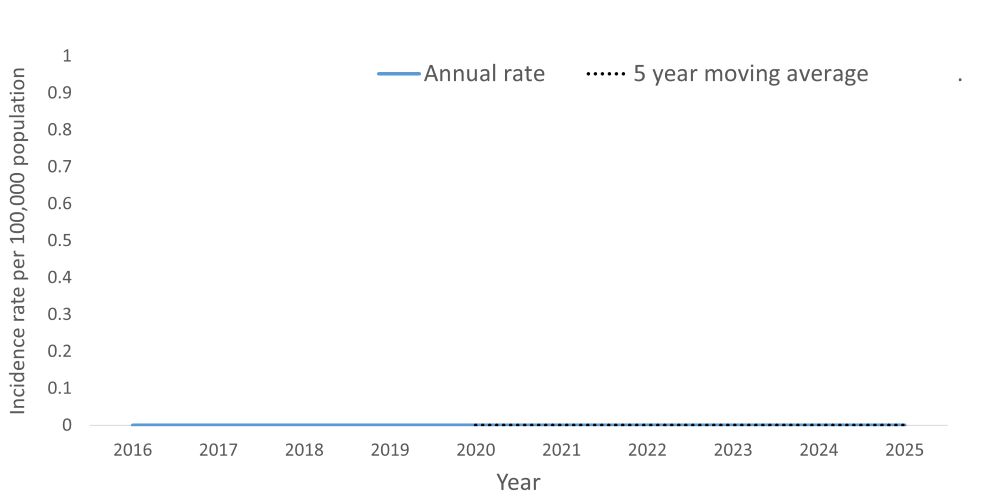
Incidence rate per 100,000 in 2025: 0
*Includes confirmed cases in 2025.
Incidence rate per 100,000 of hemorrhagic fevers by year
More information about hemorrhagic fevers
Public Health Agency of Canada:
- Ebola disease: Symptoms and treatment
- Lassa Fever
- Marburg virus disease
- Dengue fever
- Yellow fever
- Rift valley fever fact sheet
World Health Organization:
U.S. Centers for Disease Control and Prevention:
Report to the Health Unit immediately by fax (705-482-0670) and phone at 705-474-1400 or toll free at 1-800-563-2808, ext. 5229 if hemorrhagic fever is suspected or confirmed as per Ontario Regulation 135/18 and amendments under the Health Protection and Promotion Act, R.S.O., c.H.7.
After hours, weekends, and holidays, call 705-474-1400 then press 0 to speak with the Answering Service. The on-call CDC Public Health Nurse will get back to you as soon as possible.
Additionally, VHFs are designated special pathogens, all health sector organizations that suspect a special pathogen should immediately notify the Ministry of Health through the Health Care Provider Hotline at 1-866-212-2272.
Should one go to childcare, school, or work if they have hemorrhagic fever?
Contact the Health Unit.
Only yellow fever is preventable by vaccination. Check your vaccination records or call the Vaccine Preventable Diseases program at 705-474-1400 or toll free at 1-800-563-2808, ext. 5252 to obtain information about where to receive a yellow fever vaccination.
Healthcare provider information
Public Health Ontario’s Viral Hemorrhagic Fever Risk Assessment Tool can be used to support clinicians in conducting a comprehensive clinical risk assessment for VHF including evaluation of the patient’s clinical presentation, travel to areas with endemic VHF or suspected/confirmed outbreaks, and relevant exposures within 21 days of symptom onset. A positive response in a single section should not be used on its own to indicate VHF suspicion. Clinicians should base decisions regarding VHF suspicion on the overall clinical risk assessment.
See also: Public Health Ontario’s VHF Triage Assessment Algorithm.
Infection prevention and control
Acute Care: Infection Prevention and Control Management of VHF in Acute Care
- Summary of IPAC Recommendations for Preventing VHF Transmission in Acute Care
- Infection Prevention and Control Guidance for Viral Hemorrhagic Fever Specimen Collection and Handling in Acute Care Settings
Pre-Hospital Care and Ground Transport: Infection Prevention and Control Management of VHF in Pre-Hospital Care and Ground Transport
Donning and Doffing Personal Protective Equipment (PPE):
Viral Hemorrhagic Fevers are a Risk Group 4 Pathogen. In accordance with Transportation of Dangerous Goods Regulations, shipping clinical specimens suspected of Risk Group 4 pathogens require Category A packaging (section 2.36) and an Emergency Response Assistance Plan (ERAP) (section 7.2(1)(g)).
Before collecting specimens, the clinician should complete the Public Health Ontario’s Viral Hemorrhagic Fever Risk Assessment Tool and consult with the Ministry of Health as per the Notification Pathway for Special Pathogens.
For more information see Public Health Ontario’s:
Post-Exposure Prophylaxis (PEP)
The Ebola Vaccine (Ervebo®) is authorized in Canada but is currently not available or recommended for Canadians as part of routine immunization or for vaccination prior to travel. The vaccine should be offered as post-exposure prophylaxis to persons who have been exposed to Ebola Virus Disease (Orthoebolavirus zairense) and is available via the National Emergency Strategic Stockpile. See the Canadian Immunization Guide: Ebola virus vaccine for additional information.
Ministry of Health Infectious Diseases Protocol, Appendix 1, Disease: Viral Hemorrhagic Fevers caused by i) Ebola virus, ii) Marburg virus, iii) Lassa virus, or (iv) Other viral agents including arenaviruses, bunyaviruses, filoviruses, and flaviviruses
Contact our Communicable Disease Control (CDC) program at 705-474-1400 or toll free at 1-800-563-2808, ext. 5229, or by email to cdc@healthunit.ca for more information.
Last updated: July 2026, by CDC