
- Case counts (2016-2025), population estimates (2016-2023), & population projections (2024-2025): Public Health Ontario.
- Query: Case counts of reportable diseases by public health unit and year. Toronto, ON: Ontario Agency for Health Protection and Promotion; extracted on March 9, 2026.
Pertussis
Whooping Cough
Pertussis, also known as whooping cough, is a contagious infection of the lungs and airways.
It is caused by the bacteria called Bordetella pertussis. Pertussis is a disease that happens year-round everywhere in the world.
Pertussis causes serious coughing fits that can lead to choking or vomiting. The coughing can be so intense that a "whooping" sounds happens when you try to catch your next breath. Listen to the sound of whooping cough (pertussis) in a baby.
Local Information
2025 Statistics
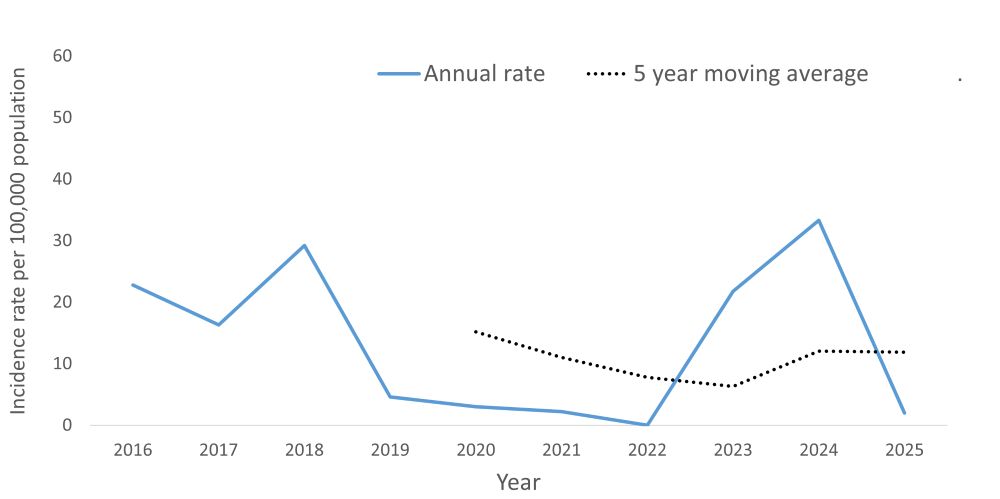
Incidence rate is the number of new cases of disease divided by the number of persons at risk for the disease during a particular time period.
Cases:
3*
Incidence rate per 100,000 in 2025: 2
*Includes confirmed and probable cases in 2025.
Incidence rate per 100,000 of pertussis (whooping cough) by year
More information about pertussis
Public Health Agency of Canada:
Ministry of Health:
If you think you have pertussis (whooping cough), contact your healthcare provider or call Telehealth at 1-866-797-0000. Call ahead before going to a healthcare provider's office or hospital, so that they can prepare and protect other patients.
Report to the Health Unit within one business day by fax (705-482-0670) or phone at 705-474-1400 or toll free at 1-800-563-2808, ext. 5229 if pertussis (whooping cough) is suspected or confirmed as per Ontario Regulation 135/18 and amendments under the Health Protection and Promotion Act, R.S.O., c.H.7.
Should one go to childcare, school, or work if they have pertussis (whooping cough)?
Contact the Communicable Disease Control (CDC) program for specific directions.
Stay home until you are well. Avoid contact with young children, infants, and pregnant individuals until appropriate antibiotics have been taken for five full days.
If no treatment is given, avoid contact with these individuals for three full weeks from the start of a cough. Exclusion may also be required from work, school, childcare, or recreational/summer camp.
Note: Exclusion guidelines may differ for healthcare workers, those who work with vulnerable populations, childcare attendees or workers, and those who have direct contact with infants less than one year of age and pregnant individuals in their third trimester. Follow the direction of your healthcare provider, public health case manager, and/or occupational health at your workplace.
Pertussis (whooping cough) is preventable by vaccination. Check your vaccination records or call the Vaccine Preventable Diseases program at 705-474-1400 or toll free at 1-800-563-2808, ext. 5252 to book a vaccination appointment or if you have any vaccine-related questions.
Family members and caregivers of infants and young children should get vaccinated if they are not up to date with their pertussis (whooping cough) vaccine. The vaccine is only available as part of a vaccine that also has tetanus and diphtheria vaccine in it; it may also contain polio vaccine depending on the vaccine required. Everyone should receive five needles in childhood, one needle in their teens and one needle in adulthood. The pertussis (whooping cough) vaccine is given at:
- 2, 4, 6 and 18 months of age
- 4 to 6 years of age
- 14 to 16 years of age
- One dose in adulthood
- in each pregnancy, ideally between 27 to 32 weeks of gestation
See the Adacel® Information webpage.
Healthcare provider information
Infection prevention and control
In healthcare settings, droplet precautions are to be used for five days after the start of treatment, or for three weeks from the onset of cough if not treated.
Public Health Ontario:
Post-exposure prophylaxis (PEP)
Macrolide antibiotics such as azithromycin and erythromycin may prevent or moderate clinical pertussis when given during the incubation period or in the early catarrhal stage. During the paroxysmal phase of the disease, antibiotics may not shorten the clinical course but may reduce the possibility of complications. Antibiotics eliminate the organism after a few days of use and thus reduce transmission.
Chemoprophylaxis is only recommended for:
- Household contacts of the case (including attendees at home childcare settings) where there is an infant under 1 year of age (immunized or not) or a pregnant individual in their third trimester within the home
- For out of household exposures, infants less than one year of age, regardless of immunization status and pregnant individuals in their third trimester who have had face-to-face exposure and/or have shared confined air with the case for greater than 1 hour.
Chemoprophylaxis should be implemented as soon as possible after the exposure as efficacy is related to early implementation. It is not likely to be beneficial after 21 days since the first contact with the case. Laboratory diagnostic testing of contacts should not be done to guide decisions around who should receive chemoprophylaxis.
For information on the specific antimicrobials indicated for chemoprophylaxis among contacts without contradictions, see the Ministry of Health’s Infectious Diseases Protocol, Appendix 1: Case Definitions and Disease-Specific Information, Disease: Pertussis (Whooping Cough).
Ministry of Health - Ontario Public Health Standards:
Public Health Ontario:
Public Health Agency of Canada:
Contact our Communicable Disease Control (CDC) program at 705-474-1400 or toll free at 1-800-563-2808, ext. 5229, or by email at cdc@healthunit.ca for more information.
Last updated: July 2026, by CDC