
- Case counts (2016-2025), population estimates (2016-2023), & population projections (2024-2025): Public Health Ontario.
- Query: Case counts of reportable diseases by public health unit and year. Toronto, ON: Ontario Agency for Health Protection and Promotion; extracted on March 9, 2026.
Lyme Disease
Lyme disease is an infection transmitted through the bite of an infected blacklegged tick, also called a deer tick. These ticks are in our region and are also spreading to new areas of the province, sometimes travelling on birds and deer.
Ticks are most active in spring and summer but can be found at any time of the year when the temperature is above freezing (0oC). As we experience global warming, ticks are becoming a greater concern.
Infections brought on by blacklegged tick bites, including Lyme disease, anaplasmosis, babesiosis, Powassan virus, can be serious. Not all blacklegged ticks carry the infectious agents that cause infections, and not everyone who is bitten by an infected tick will develop signs and symptoms of these diseases.
See the Ministry of Health’s Tick-Borne Diseases webpage for information about:
- What blacklegged ticks look like and where they live
- How to avoid getting a tick bite and how to remove a tick
- Tick testing
- Signs and symptoms, diagnosis, and treatment
Found a tick on you?
If you find a tick on you or someone else, remove it right away.
How to Remove a Tick
- Use fine-tip tweezers or a tick removal tool to grab the tick close to the skin, at its head.
- Pull straight up. Do not twist.
- Place it in a container and get it identified on eTick.ca.
- Wash the bite area.
When to Seek Help
Visit your healthcare provider as soon as possible if you:
- are not comfortable with removing a tick
- cannot remove the tick because it has buried itself deep into your skin
- have concerns after being bitten by a tick
- aren't felling well, or have any symptoms.
For tick-related concerns regarding pets, call your vet clinic.
Contact our Environmental Health program for more information. They can be reached at 705-474-1400 or toll-free at 1-800-563-2808, ext. 5400.
Laboratory testing is for surveillance purposes only and is not intended to replace clinic guidance.

Know Your Tick.
Submit a photo of your tick and find out its species within 48 hours on eTick.ca.

Know Your Risk.
Bit by a tick? Find out your risk of Lyme disease and get a recommendation on what to do next using our Risk Tool.
Local Information
2025 Statistics
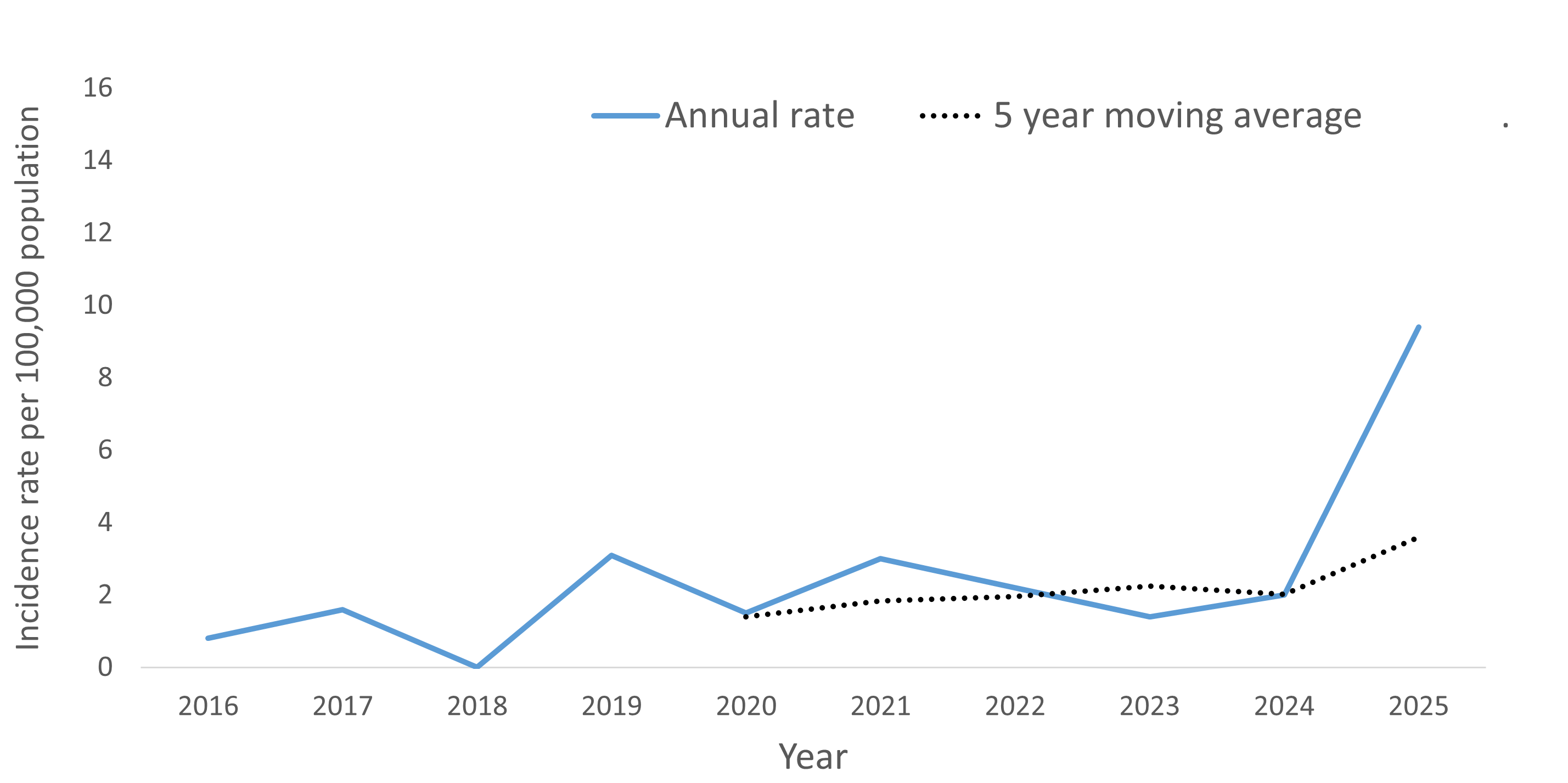
Incidence rate is the number of new cases of a disease divided by the number of persons at risk for the disease during a particular time period.
Cases:
14*
Incidence rate per 100,000 in 2025: 9.4
*Includes confirmed and probable cases in 2025.
Incidence rate per 100,000 of Lyme disease by year
More information about Lyme disease
Public Health Agency of Canada:
Tick Prevention, Management, and Safety
Report to the Health Unit within one business day by fax (705-482-0670) or phone at 705-474-1400 or toll free at 1-800-563-2808, ext. 5229 if Lyme disease is suspected or confirmed as per Ontario Regulation 135/18 and amendments under the Health Protection and Promotion Act, R.S.O., c.H.7.
Should one go to childcare, school, or work if they have Lyme disease?
Healthcare provider information
Public Health Ontario:
Ontario Health:
Public Health Agency of Canada:
Public Health Ontario:
Public Health Ontario:
- Lyme disease
- Ontario Vector-Borne Diseases Tool (including risk area map)
Ministry of Health - Ontario Public Health Standards:
For more information please contact the Communicable Disease Control Program at 705-474-1400 or 1-800-563-2808, ext. 5229 or by email at cdc@healthunit.ca
Last updated: Mar. 2026, by CDC