Commanda Lake (Restoule)
- Lake Nipissing, Callander Bay (Municipality of Callander)
- Wasi Lake (Township of Chisholm)
- Whitestone Lake (Municipality of Whitestone)
- Old Man's Lake (Township of Magnetawan)
- Whalley Lake (Township of Magnetawan)
(Cyanobacteria or Harmful Algal Bloom (HAB))
Blue-green Algae
Report a suspected blue-green algae bloom
There are two ways to report:
- https://report-pollution.ene.gov.on.ca/
- Call the Ministry of the Environment, Conservation and Parks (MECP) Spills Action Centre 24 hours a day, 7 days a week:
- Toll-free: 1-866-MOE-TIPS (663-8477)
- Toll-free TTY: 1-855-889-5775
The MECP will collaborate with the health unit and investigate reports to determine the presence of blue-green algae and levels of blue‑green algae toxins.
What is blue-green algae
Naturally occurring microscopic plant-like organisms that thrive in warm, calm, nutrient‑rich waters (high in nitrogen and phosphorus). Populations of blue-green algae can rapidly increase to form a large mass or scum, called a bloom. Blooms are most common in late summer or early fall but can also occur in other seasons. Some varieties of blue-green algae can produce cyanotoxins, which are harmful to humans and animals.
Key Characteristics:
- Appearance: Blooms often resemble spilled green paint, turquoise paint, pea soup, or globs of scum on the water surface. When a bloom very dense, it may form solid-looking mats.
- Color: While typically blue-green, they can also appear brown, red, purple or yellow.
- Location: Common in warm, slow-moving or shallow water.
- Smell: Decomposing blooms can produce a musty, grassy, or fishy smell.
- Distinction from Algae: Unlike harmless algae, cyanobacteria can produce cyanotoxins that are dangerous to human and animal health. (Blue-green algae | ontario.ca)
Climate change is creating warmer air and water temperatures, more precipitation events and droughts, which can all strengthen the growth and toxicity of algal blooms.
Residents living near a lake with a blue-green algae bloom may be affected depending on how close they are to the bloom, the size of the lake, wind direction, water movement, and other environmental factors that cannot be predicted or controlled. Because of these variables, government authorities cannot determine exactly where or when toxins may be present. Individuals are advised to use caution and their own judgment.
Safety Measures
If you live near where a bloom was detected or are visiting a lake and notice algae, follow these safety measures:
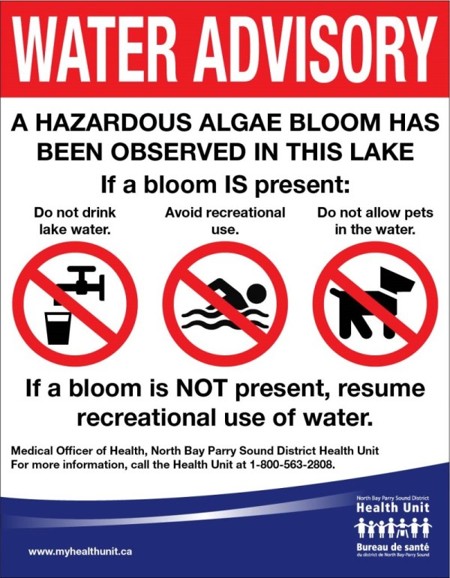
- Do not use the water from the waterbody for drinking, cooking, bathing, and brushing teeth. Note: Using a private water treatment system or boiling the water will not destroy the toxins.
- Do not swim or take part in water sports where harmful algae are present
- There is low risk to human health if you eat fish caught during a blue-green algae bloom. Toxins associated with blooms do not accumulate at high levels in fish fillets, however higher levels of toxins have been found in the livers of fish from waterbodies that regularly have blue-green algal blooms, even when a bloom is not present. Avoid eating any fish organs to eliminate this risk. Take care not to cut the organs of fish when filleting.
- If skin contact does occur, wash with soap and water or rinse thoroughly with clean water to remove algae.
If you use a private water system for your drinking water:
If you get your water supply from your own surface water intake in the area of a blue-green algal bloom, you should seek an alternate source of drinking water (i.e. bottled water or another safe source). Home treatment systems may not remove cyanotoxins. Do not boil or manually treat the water with chlorine or other disinfectants, this does not remove the toxins. Avoid using chemicals like herbicides, copper sulphate, or algaecides to kill the bloom, as this can release more toxins.
If you have your own well supply with a groundwater source (not under the influence of surface water) or you receive trucked-in water, you can continue to use the water normally during a blue-green algae bloom.
Confirmed Blue-green Algae Blooms
All water bodies in our region are at risk of algae blooms. Precautions should always be taken during recreational use or when using water for drinking purposes.
After a suspected bloom is reported to the MECP, water samples are collected and submitted to the Ministry of the Environment, Conservation and Parks laboratory. Based on microscopic analysis of the algal material in the sample, the presence of blue‑green algae is identified at specific locations, which are shown on our map of blue-green algae bloom locations. Once the MECP confirms that a sample can produce the toxins, it is determined whether the location is new or recurring. If a new bloom location is identified, a Public Service Announcement is issued.

When is it safe to swim after a harmful blue-green algae bloom advisory has been released?
An advisory does not close the beach but rather advises swimmers that they need to take caution in the area. Avoid swimming if a bloom is present.
When will the public be made aware when an advisory is lifted?
Harmful blue-green algae can come and go throughout the season. The advisory does not close the beach, rather informs swimmers to be aware that there could be a bloom in the area. Therefore, the advisory stays in place all summer, however, this does not mean the bloom will be there all summer. Look for signs of the bloom and if none are present, swimming may take place.
All water bodies in our region are at risk of an algal bloom. Precautions should be taken when using water bodies for recreation purposes or drinking water, regardless of whether a harmful algae bloom has been confirmed.
After blooms are reported, samples are taken and submitted to the Ministry of Environment Conservation and Parks Lab. Based on the microscopic analysis of the algal material present in the sample, blue green algae has been found at the following locations: Our map of HAB locations.
Confirmed and Previous Blue-green Algae Blooms (HAB)
- Ahmic Lake (Township of Magnetawan)
- Bear Lake (Sprucedale, McMurrich Monteith Township)
- Commanda Lake (Restoule)
- Eagle Lake (Township of Machar)
- Lake Bernard (Village of Sundridge)
- Lake Nipissing, Callander Bay (Municipality of Callander)
- Lake Nipissing, North Bay Water Front (City of North Bay)
- Lake Nosbonsing (Township of Bonfield)
- Little Tyne Lake (Township of Ballantyne)
- McQuaby Lake (Township of Nipissing)
- Pickeral Lake (Township of Armour)
- Ruth Lake (Township of Nipissing)
- Wasi Lake (Township of Chisholm)
- Whitestone Lake (Township of Hagerman)
- Blind Bay, Killbear Provincial Park (Township of Carling)
- Lake Bernard (Village of Sundridge)
- Wasi Lake (Township of Chisholm)
- Deer Lake (Township of Lount)
- Jack's Lake (Township of Armour)
- Lake Bernard (Village of Sundridge)
- Lake Nipissing, in the north West Bay, near Lavigne (Municipality of West Nipissing)
- Ruth Lake (Township of Nipissing)
- Commanda Lake (Restoule)
- Lake Nipissing, Callander Bay (Municipality of Callander)
- Lake Nipissing, south shore (Township of Nipissing)
- Lake Nosbonsing (Municipality of East Ferris and Township of Bonfield)
- Legrou Lake (Arnstein)
- Ruth Lake (Township of Nipissing)
- Sturgeon Bay (Township of Archipelago)
- Talon Lake (Township of Bonfield)
- Tucker Lake (Township of Seguin)
- Wasi Lake (Township of Chisholm)
- Commanda Lake (Restoule)
- Harris Lake (Municipality of McDougall)
- Lake Bernard (Village of Sundridge)
- Lake Nipissing, Callander Bay (Municipality of Callander)
- Lake Nipissing, south shore area (Township of Nipissing)
- Lake Nosbonsing (Municipality of East Ferris and Township of Bonfield)
- Manitouwabing Lake (Township of McKellar)
- Tucker Lake (Town of Parry Sound and Township of Seguin)
- Whitestone Lake (Dunchurch)
- Lake Bernard (Village of Sundridge)
- Lake Nipissing (Campbell’s Bay in Patterson Township and Simpson’s Bay in Nipissing Township)
- Lake Nipissing, Marathon Beach (City of North Bay) and Centennial Park Beach (Municipality of Callander)
- Lake Nipissing, north West Bay area, near Lavigne (Municipality of West Nipissing)
- Lake Nipissing, North Bay Marina and Kinsmen Beach (City of North Bay)
- Lake Nosbonsing (Municipality of East Ferris and Township of Bonfield)
- McQuaby Lake (Township of Nipissing)
- Sand Lake (Town of Kearney)
- Talon Lake, McCool Bay (Township of Bonfield)
- Wasi Lake (Township of Chisholm)
- Deer Lake, western part (Township of Lount)
- Lake Bernard, northwest part (Township of Strong)
- Lake Nipissing, Callander Bay, east end of Lake Nipissing (Municipality of Callander)
- Lake Nosbonsing (Township of Bonfield)
- Lake Talon (Township of Bonfield)
- Lynx Lake, previously known as Groom Lake (Town of Kearney)
- Ottawa River near the Village of Thorne (Township of Poitras)
- Pickerel Lake, previously known as Jack Lake (Township of Armour)
- Rankin Lake, east area (Township of Seguin)
- Roberts Lake, north end of lake (Township of Seguin)
- Three Mile Lake (Township of Armour)
- Tilden Lake (Nipissing District)
2017
- Lake Bernard (Village of Sundridge)
- Lake Nipissing, Callander Bay (Municipality of Callander)
- Lake Nosbonsing (Municipality of East Ferris)
- Lake Talon (Township of Bonfield)
- Lynx Lake, previously known as Groom Lake (Town of Kearney)
- McQuaby Lake (Township of Nipissing)
- Ottawa River (Unorganized township)
- Pickerel Lake (Township of Armour)
- Sturgeon Bay (Township of the Archipelago)
- Whalley Lake (Municipality of Magnetawan)
2016
- Jack Lake (Township of Armour)
- Lake Nipissing (Municipality of Callander)
- Otter Lake (Township of Seguin)
- Shebeshekong (Township of Carling)
- West Arm of Lake Nipissing (Municipality of West Nipissing)
- Whalley Lake (Municipality of Magnetawan)
2015
- Campbell Lake (Municipality of McDougall)
- Clear Lake (Township of Perry)
- Deer Lake (Township of Lount)
- Eagle Lake (Township of Machar)
- Horseshoe Lake (Township of Seguin)
- Jack Lake (Township of Armour)
- Lake Bernard (Village of Sundridge)
- Lake Nipissing, Callander Bay (Municipality of Callander)
- Lake Nosbonsing (Township of Bonfield)
- Lake Nipissing (Municipality of West Nipissing)
- Lake Nipissing (City of North Bay)
- McQuaby Lake (Township of Nipissing)
- Pickerel River (Unorganized Township)
- Talon Lake (Township of Bonfield)
- Wasi Lake (Township of Chisholm)
2014
- Cache Lake (Municipality of West Nipissing)
- Clear Lake (Township of Perry)
- McQuaby Lake (Township of Nipissing)
- Ruth Lake (Township of Nipissing)
- Talon Lake (Township of Bonfield)
2013
- Lake Nipissing, Callander Bay (Municipality of Callander)
2012
- Kaibuskong River (Township of Bonfield)
- Lake Nipissing, Callander Bay (Municipality of Callander)
- Lake Nipissing, Goose Island Lake (Municipality of West Nipissing)
- Lake Nosbonsing (Municipality of East Ferris)
- Lake Talon (Township of Bonfield)
- Pointe au Baril channel (Township of the Archipelago)
2011
- Lake Nipissing, Callander Bay (Municipality of Callander)
- Pickerel River (Unorganized township)
- Silver Lake
- Sturgeon Bay Provincial Park (Township of the Archipelago)
- Tilden Lake (Unorganized township)
- Trout Lake, Dugas Bay (City of North Bay)
- Wasi Lake (Township of Chisholm)
More Resources:
· Cyanobacterial Toxins in Drinking Water- Information on cyanobacteria in drinking water and how they are managed in Canada
· Guidelines for Canadian Recreational Water Quality: Cyanobacteria and their Toxins Health Canada-Details on cyanobacteria in recreational waters and related health concerns