
- Case counts (2016-2025), population estimates (2016-2023), & population projections (2024-2025): Public Health Ontario.
- Query: Case counts of reportable diseases by public health unit and year. Toronto, ON: Ontario Agency for Health Protection and Promotion; extracted on March 9, 2026.
Botulism
Clostridium botulinum
Botulism is a rare but serious illness caused by a toxin produced by the bacteria Clostridium botulinum. Illness can occur through eating food contaminated with the toxin, infection of an open wound, or particularly in babies, ingestion of spores that form toxins in the intestine. The treatment for botulism is an anti-toxin medication that neutralizes the toxin.
Local Information
2025 Statistics
Incidence rate is the number of new cases of disease divided by the number of persons at risk for the disease during a particular time period.
Cases:
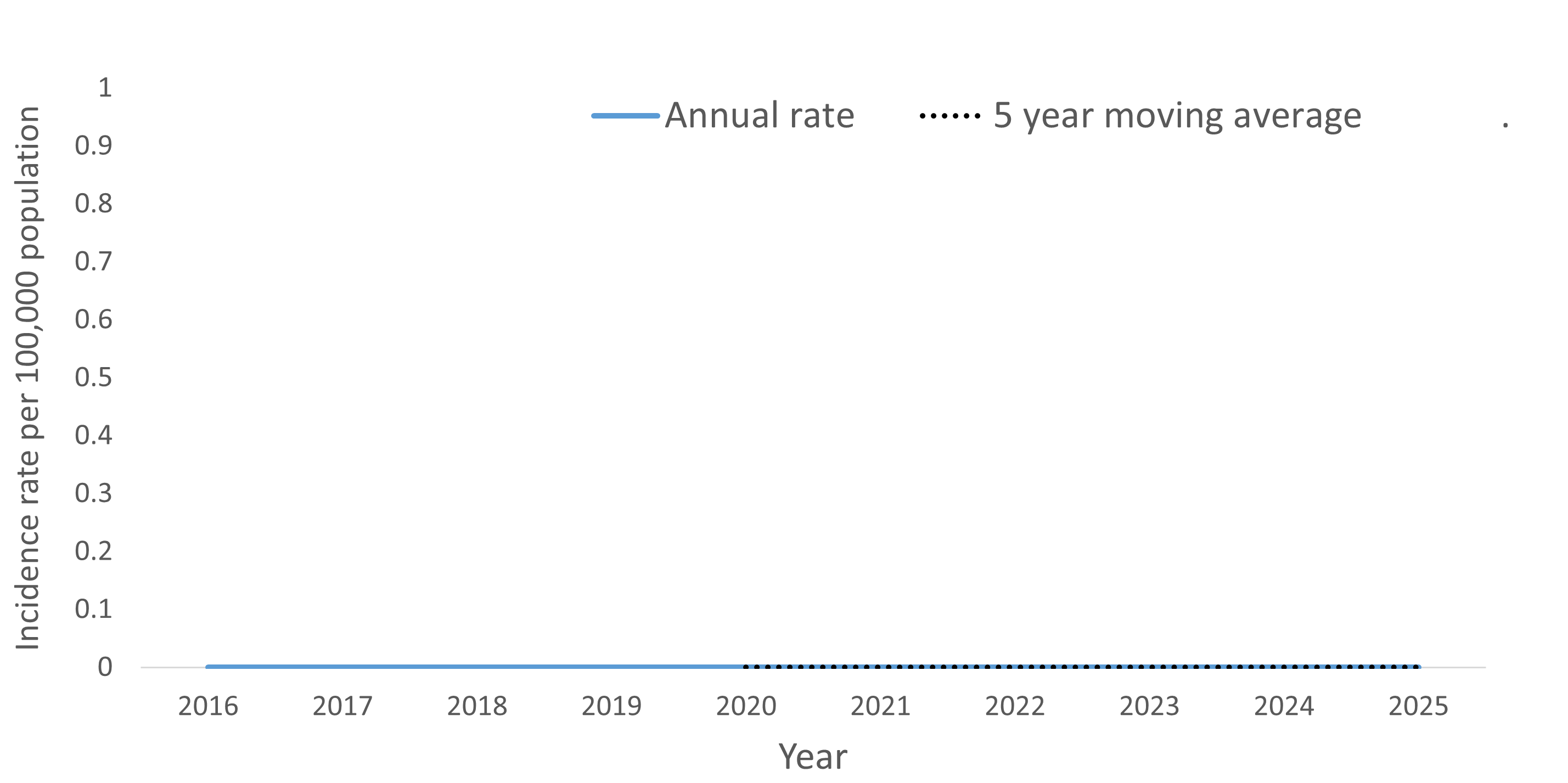
0*
Incidence rate per 100,000 in 2025: 0
*Includes confirmed cases in 2025.
Incidence rate per 100,000 of botulism by year
More information about botulism
Public Health Agency of Canada:
Report to the Health Unit immediately by fax (705-482-0670) and phone at 705-474-1400 or toll free at 1-800-563-2808, ext. 5229 if botulism is suspected or confirmed as per Ontario Regulation 135/18 and amendments under the Health Protection and Promotion Act, R.S.O., c.H.7.
After hours, weekends, and holidays, call 705-474-1400 then press 0 to speak with the Answering Service. The on-call CDC Public Health Nurse will get back to you as soon as possible.
Should one go to childcare, school, or work if they have botulism?
No exclusion necessary as people exposed to botulism are not contagious.
Healthcare provider information
HCP information about botulism
There are four main forms of botulism: foodborne, infant, adult intestinal colonization and wound. All forms produce the same neurological signs and symptoms of symmetrical cranial nerve palsies followed by descending, symmetric flaccid paralysis of voluntary muscles, which may progress to respiratory compromise and death. Additional symptoms (e.g., gastrointestinal signs in foodborne cases) may also be seen in some forms. Refer to the Botulism Guide for Health Care Professionals (Ministry of Health, 2023) for guidance when botulism is suspected.
Contact a member of the Botulism Reference Service for Canada when a case of botulism is suspected to discuss the clinical presentation of the suspect case of botulism in order to support the diagnosis, and make arrangements for transporting suspect food and clinical specimens to Ottawa for laboratory analysis. Clinical specimens must be obtained prior to administering botulism antitoxin.
Immediate medical treatment is required, do not await laboratory confirmation. Botulinum Antitoxin (BAT) is generally used for adult cases; human Botulism Immune Globulin Intravenous (BabyBIG®) is indicated for the treatment of infant botulism in infants under one year of age.
Treating clinicians must obtain approval for use of BabyBIG® through Health Canada’s Special Access Programme (SAP). While there is a recommended dose of BAT for infants less than one year of age, the ministry supports clinicians in the ordering and use of BabyBIG® due to the lack of evidence for use of BAT in infant cases as per the product monograph.
Refer to Botulism Guide for Health Care Professionals (Ministry of Health, 2023) for information on the process for ordering BAT or BabyBIG®.
Infection prevention and control
No instance of secondary person-to-person transmission has been documented. Routine practices are recommended for cases while hospitalized.
Post-exposure prophylaxis (PEP)
Antitoxin prophylaxis for individuals who do not display symptoms consistent with botulism is not recommended due to the risk of serum sickness and hypersensitivity reactions associated with antitoxin administration.
Public Health Agency of Canada:
Contact our Communicable Disease Control (CDC) program at 705-474-1400 or toll free at 1-800-563-2808, ext. 5229, or by email to cdc@healthunit.ca for more information.
Last updated: Feb 2026, by CDC