
- Case counts (2016-2025), population estimates (2016-2023), & population projections (2024-2025): Public Health Ontario.
- Query: Case counts of reportable diseases by public health unit and year. Toronto, ON: Ontario Agency for Health Protection and Promotion; extracted on March 9, 2026.
Amebiasis
Amebiasis is an intestinal infection caused by the tiny, microscopic parasite Entamoeba histolytica (E. histolytica). It is typically a travel-related disease. Amebiasis occurs worldwide but is more common in regions with poor sanitation. It can be spread from person to person through direct contact, or by consuming food or water contaminated with human feces.
Local Information
2025 Statistics
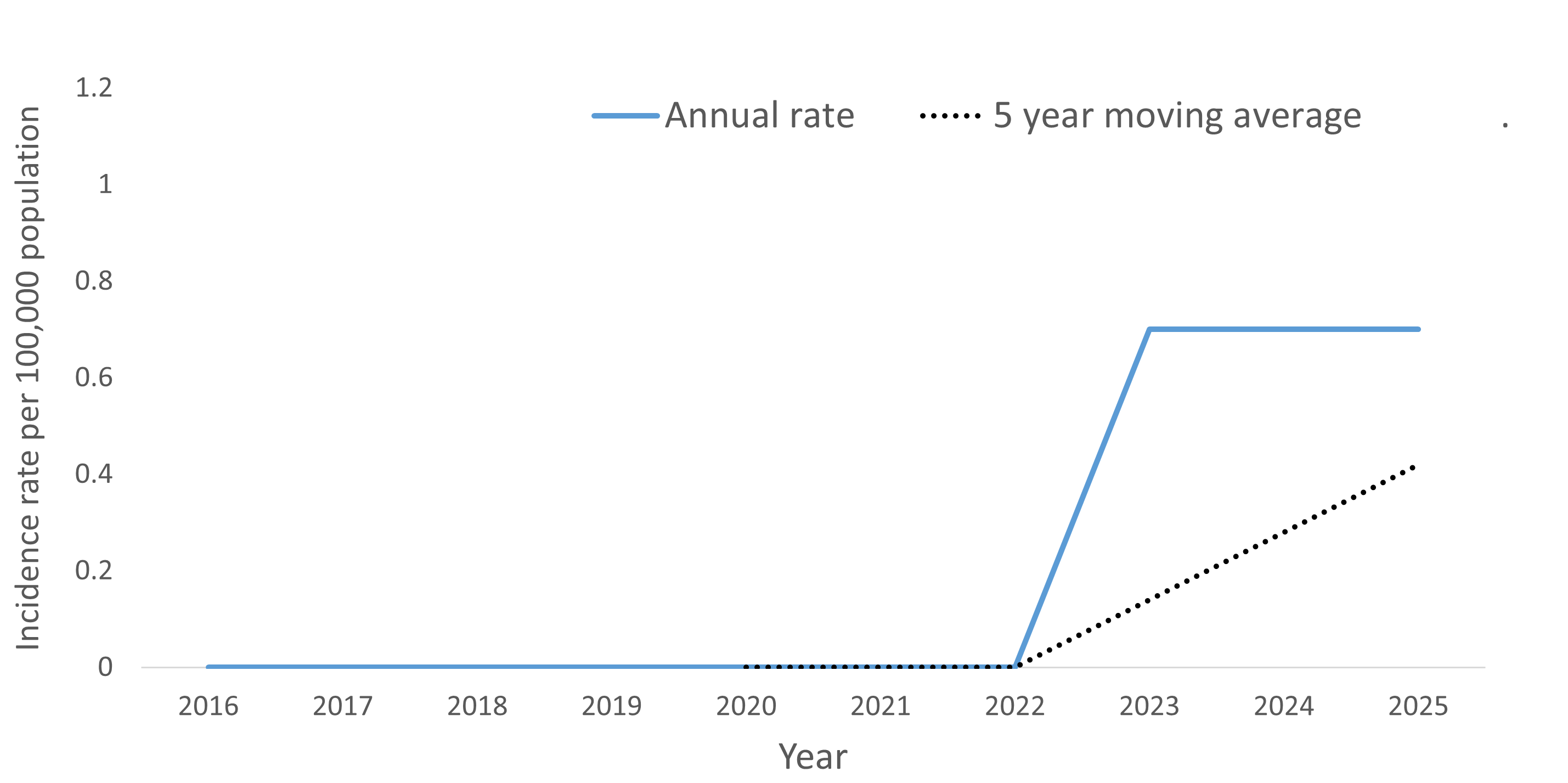
Incidence rate is the number of new cases of disease divided by the number of persons at risk for the disease during a particular time period.
Cases:
1*
Incidence rate per 100,000 in 2025: 0.7
*Includes confirmed and probable cases in 2025.
Incidence rate per 100,000 of amebiasis by year
More information about amebiasis
See our Amebiasis fact sheet.
Report to the Health Unit within one business day by fax (705-482-0670) or by phone at 705-474-1400 or toll free at 1-800-563-2808, ext. 5229 if amebiasis is suspected or confirmed as per Ontario Regulation 135/18 and amendments under the Health Protection and Promotion Act, R.S.O., c.H.7.
Should one go to childcare, school, or work if they have amebiasis?
Those with symptoms should be excluded from conducting activities in high-risk settings, such as the food industry, healthcare, or childcare, for 24 hours after diarrhea resolves, or for 48 hours after completion of treatment.
Follow the direction of your healthcare provider, public health case manager, or occupational health at your workplace.
Healthcare provider information
Asymptomatic individuals carrying the pathogen can be treated with luminal amebicides (kills cysts).
Symptomatic individuals should be treated with tissue amebicides (kills trophozoites), followed by a luminal amebicide to eliminate any surviving organisms in the colon.
Therapeutic aspiration/drainage of an amebic liver may be required, alone or along with antiparasitic therapy, in patients who do not respond to therapy.
Infection prevention and control
For hospitalized individuals, enteric precautions in the handling of feces, contaminated clothing, and bed linen.
The diagnostic approach differs based on whether the infection is intestinal or extraintestinal (i.e. liver abscess).
Intestinal Amebiasis (PCR Stool Testing)
- If intestinal amebiasis is strongly suspected, multiple stool specimens (up to six) should be collected every other day until a diagnosis is made due to the intermittent shedding of the organism and the limited sensitivity of a single stool specimen.
- For additional information and instruction on specimen collection, refer to Public Health Ontario Lab’s (PHOL) Test Information Sheet on Enteric Protozoa (Cryptosporidium, Cyclospora, Dientamoeba, Entamoeba, and Giardia) - PCR.
External Amebiasis (Sterile body fluid/Tissue/Serum/Clotted Blood)
- Microscopy, PCR, and serology may be indicated for the diagnosis of individuals suspected of extraintestinal amebiasis (e.g. amebic liver, brain, lung, or other abscess; or perineal ulcerative lesions), in addition to histopathology.
- For additional information and instruction on specimen collection, refer to Public Health Ontario Lab’s (PHOL) Test Information Sheet on Extraintestinal Entamoeba histolytica (Amebic Abscess) – Microscopy, PRC, and Antibody.
Ministry of Health: Ontario Public Health Standards:
Public Health Ontario
Public Health Agency of Canada
Heymann, D. L. (Ed.). (2022). Control of Communicable Diseases Manual. (21st. ed.). American Public Health Association.
Contact our Communicable Disease Control (CDC) program at 705-474-1400 or toll free at 1-800-563-2808, ext. 5229, or by email to cdc@healthunit.ca for more information.
Last updated: Jan 2026, by CDC