
- Case counts (2016-2025), population estimates (2016-2023), & population projections (2024-2025): Public Health Ontario.
- Query: Case counts of reportable diseases by public health unit and year. Toronto, ON: Ontario Agency for Health Protection and Promotion; extracted on March 9, 2026.
Acute Flaccid Paralysis
AFP
Acute flaccid paralysis (AFP) is a rare clinical syndrome defined as the sudden onset of muscle weakness or paralysis which has many causes, both infectious and non-infectious, including poliovirus.
AFP surveillance is conducted to rule out or detect poliomyelitis (polio) which is essential to maintain Canada's polio-free certification status.
Local Information
2025 Statistics
Incidence rate is the number of new cases of disease divided by the number of persons at risk for the disease during a particular time period.
Cases:
0*
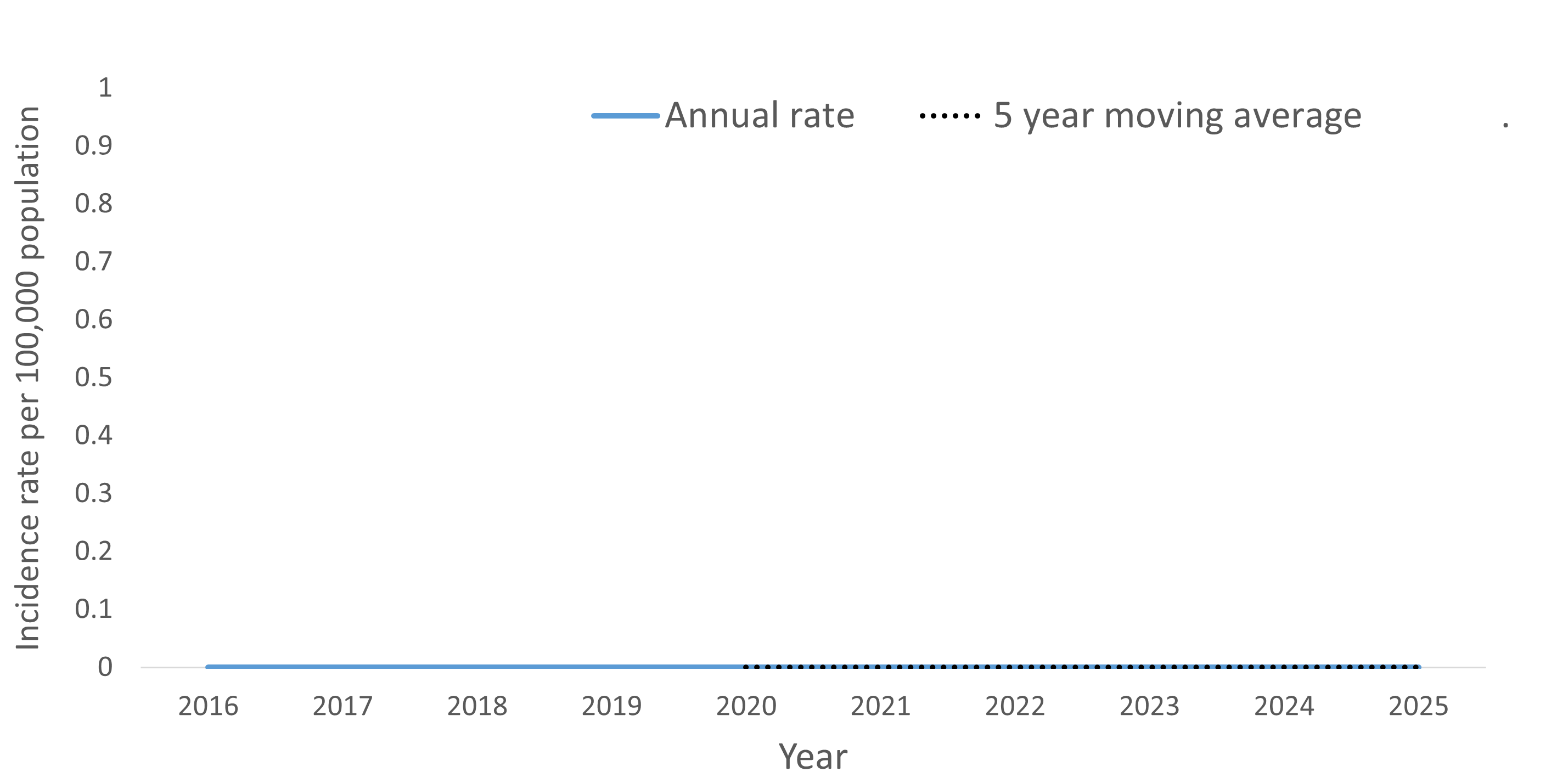
Incidence rate per 100,000 in 2025: 0
*Includes confirmed cases in 2025.
Incidence rate per 100,000 of acute flaccid paralysis by year
See our Acute flaccid paralysis fact sheet
Public Health Agency of Canada:
Report to the Health Unit within one business day by fax (705-482-0670) or phone at 705-474-1400 or toll free at 1-800-563-2808, ext. 5229 if AFP is confirmed as per Ontario Regulation 135/18 and amendments under the Health Protection and Promotion Act, R.S.O., c.H.7.
If polio is the suspected cause of acute flaccid paralysis, see the Polio webpage for reporting requirements and additional information.
Should one go to childcare, school, or work if they have AFP?
Contact the Health Unit. Exclusion depends on the cause of AFP.
AFP may be caused by poliovirus, which is preventable by vaccination. Check your vaccination records or call the Vaccine Preventable Diseases program at 705-474-1400 or toll free at 1-800-563-2808, ext. 5377 to book a vaccination appointment or to obtain additional information.
Healthcare Provider Information
No specific vaccine prevents AFP; however, the inactivated polio vaccine (IPV) prevents poliovirus related to AFP.
In Ontario, individuals immunized with polio containing vaccines begin in infancy. Refer to the Publicly Funded Immunization Schedules for Ontario for more information on eligibility and timing of publicly funded vaccines.
Refer to Poliomyelitis (polio): Canadian Immunization Guide for detailed information on polio vaccines.
Treatment is under the direction of the attending healthcare provider and will depend on the causative agent.
Infection prevention and control
Routine practices are recommended for hospitalized cases, and additional precautions would depend on the causative agent.
Refer to PHO's website to search for the most up-to-date information on Infection Prevention and Control (IPAC).
AFP may be caused by a number of agents. The immune-mediated condition Guillain-Barré Syndrome (GBS) is the most common cause of AFP in Canada.
The causes of AFP, some of which lead to GBS, include, but are not limited to, enteroviruses (including poliovirus), echoviruses, adenoviruses, West Nile virus infection, campylobacter spp., transverse myelitis, peripheral neuropathy, acute non-bacterial meningitis, brain abscess, China syndrome, post-polio sequelae, tick paralysis, myasthenia gravis, porphyria, and botulism.
Poliomyelitis must be distinguished from other paralytic conditions by isolation of poliovirus from stool.
Laboratory testing (of stool, respiratory secretions, cerebrospinal fluid (CSF) and other appropriate clinical specimens) is used to rule out and/or determine pathogens causing AFP.
- Stool samples: Collection of two stool samples within two weeks (up to six weeks) after the onset of paralysis for viral studies and campylobacter;
- Viral throat swab;
- Serology testing is not recommended for diagnosis of polio or non-polio enterovirus infection;
- Depending on the clinical presentation, a nasopharyngeal swab, and/or cerebrospinal fluid (CSF) may be collected to assist with the investigation;
- Neurologic investigations, as appropriate, should take place (electromyography, nerve conduction studies, MRI, CT).
For additional information and instruction on specimen collection, refer to Public Health Ontario Lab's (PHOL) Test Information Sheets on Enterovirus and Poliovirus.
Ministry of Health: Ontario Public Health Standards:
- Infectious Disease Protocol: Appendix 1: Acute Flaccid Paralysis (AFP)
- Infectious Disease Protocol: Appendix 1: Poliomyelitis, acute
Public Health Ontario
Public Health Agency of Canada
National Institute for Communicable Diseases:
Contact the Communicable Disease Control (CDC) Program at 705-474-1400 or toll free at 1-800-563-2808, ext. 5229, or by email to cdc@healthunit.ca for more information.
Last updated: Jan 2026, by CDC