
- Case counts (2016-2025), population estimates (2016-2023), & population projections (2024-2025): Public Health Ontario.
- Query: Case counts of reportable diseases by public health unit and year. Toronto, ON: Ontario Agency for Health Protection and Promotion; extracted on March 9, 2026.
Giardia
Beaver fever, giardiasis
Giardiasis is a diarrheal disease caused by microscopic parasites called giardia. These parasites can live in the intestines of many mammals, including humans. Although many species of giardia are found worldwide, only giardia lamblia causes infection in humans. Giardiasis is a common cause of waterborne disease in humans and is sometimes called "beaver fever".
Local Information
2025 Statistics
Incidence rate is the number of new cases of disease divided by the number of persons at risk for the disease during a particular time period.
Cases:
9*
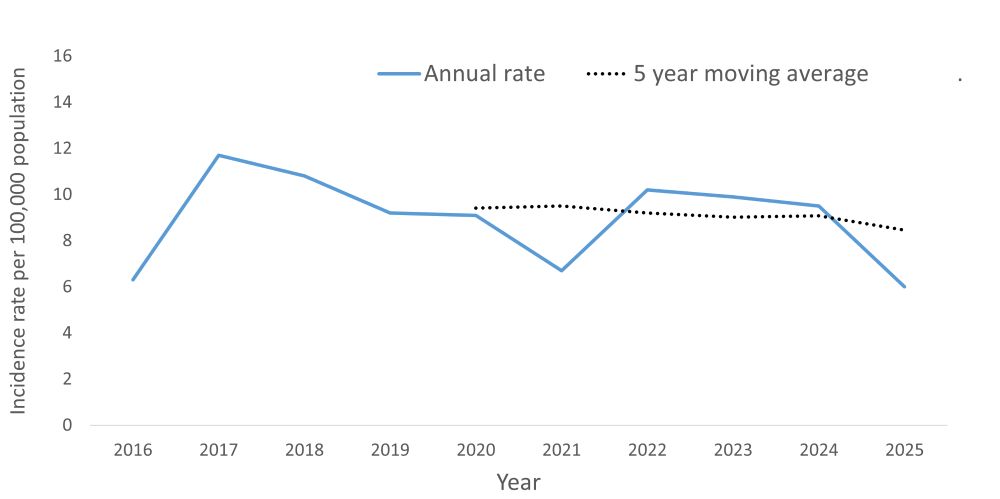
Incidence rate per 100,000 in 2025: 6
*Includes confirmed cases in 2025.
Incidence rate per 100,000 of giardiasis by year
More information about giardiasis
Public Health Agency of Canada:
Ministry of Agriculture, Food and Agribusiness:
Report to the Health Unit within one business day by fax (705-482-0670) or phone at 705-474-1400 or toll free at 1-800-563-2808, ext. 5229 if giardiasis is suspected or confirmed, as per Ontario Regulation 135/18 and amendments under the Health Protection and Promotion Act, R.S.O., c.H.7.
Should one go to childcare, school, or work if they have giardiasis?
Exclude symptomatic food handlers, healthcare providers, and childcare staff and attendees until 24 hours after diarrhea has stopped, regardless of taking antibiotics or not. If anti-diarrheal medication is taken, exclude until 48 hours after diarrhea has stopped.
Follow the direction of your healthcare provider, public health case manager, or occupational health at your workplace.
Healthcare provider information
Most people recover without treatment. If symptoms persist, treatment may be considered.
Infection prevention and control
Additional precautions
Routine practices are recommended for hospitalized adult cases. Contact precautions are recommended for paediatric and incontinent or non-adherent adult cases and placed in a single room if possible. Continue precautions until stools are formed.
Cleaning and disinfection
See the PIDAC document Best Practices for Environmental Cleaning for Infection Prevention and Control p.136
If giardiasis is strongly suspected, multiple stool specimens (up to three) should be collected every other day until a diagnosis is made due to the intermittent shedding of the organism and the limited sensitivity of a single stool specimen.
- Microscopic examination should ideally be performed on preserved specimens, otherwise Giardia trophozoites start to degrade and become undetectable within minutes of collection in unpreserved specimens leading to false negative results.
- Antigen or molecular examination should ideally be performed on unpreserved specimens, otherwise most preservatives (e.g., sodium acetate, acetic acid, and formalin [SAF]) interfere with antigenic or molecular detection leading to false negative results.
For further information about human diagnostic testing, contact PHO's laboratory services
Public Health Ontario:
Ministry of Health - Ontario Public Health Standards:
Public Health Agency of Canada:
Contact our Communicable Disease Control (CDC) program at 705-474-1400 or toll free at 1-800-563-2808, ext. 5229, or by email to cdc@healthunit.ca for more information.
Last updated: Apr 2026, by CDC