
- Case counts (2016-2025), population estimates (2016-2023), & population projections (2024-2025): Public Health Ontario.
- Query: Case counts of reportable diseases by public health unit and year. Toronto, ON: Ontario Agency for Health Protection and Promotion; extracted on March 9, 2026.
Meningococcal Disease, Invasive
Invasive meningococcal disease is caused by the bacteria Neisseria meningitidis. It is a serious disease spread from person to person through close contact with someone who has the bacteria in their nose or mouth (e.g., living in the same house, kissing or sharing items such as drinks, lipstick, cigarettes, cutlery or toys).
A person with meningococcal disease can spread the disease to others for seven days before becoming sick. It can lead to swelling of tissues surrounding the brain (meningitis) or bloodstream infection and causes complications such as hearing loss, brain damage, seizures, blood infections, and death.
Prompt medical attention and treatment are needed, as meningococcal infections can progress quickly.
Local Information
2025 Statistics
Incidence rate is the number of new cases of disease divided by the number of persons at risk for the disease during a particular time period.
Cases:
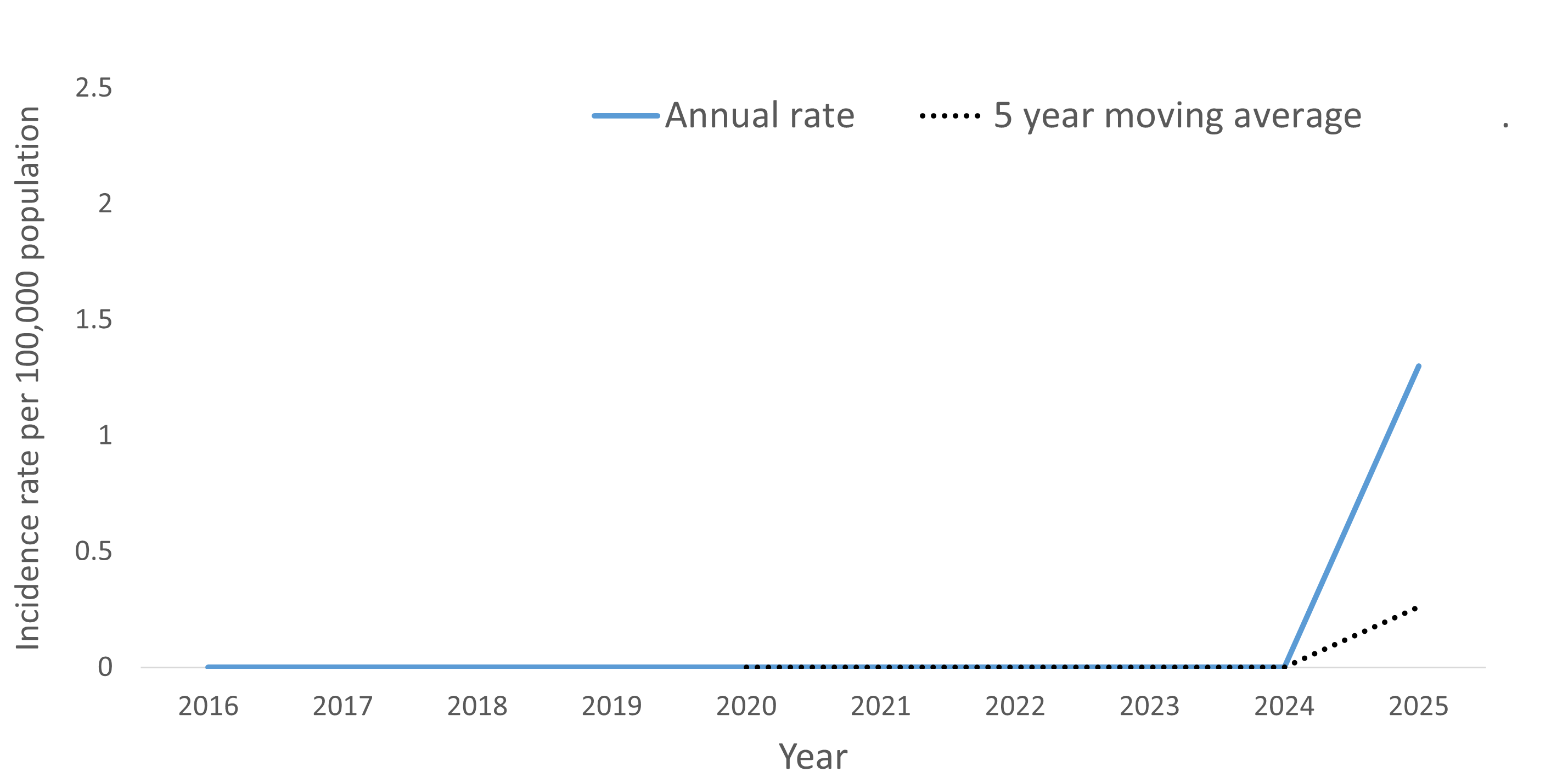
2*
Incidence rate per 100,000 in 2025: 1.3
*Includes confirmed and probable cases in 2025.
Incidence rate per 100,000 of invasive meningococcal disease by year
More information about invasive meningococcal disease
Public Health Agency of Canada:
Caring for Kids:
Ministry of Health:
See also our Meningitis webpage.
Report to the Health Unit immediately by fax (705-482-0670) and phone at 705-474-1400 or toll free at 1-800-563-2808, ext. 5229 if invasive meningococcal disease is suspected or confirmed as per Ontario Regulation 135/18 and amendments under the Health Protection and Promotion Act, R.S.O., c.H.7.
After hours, weekends, and holidays, call 705-474-1400 then press 0 to speak with the Answering Service. The on-call CDC Public Health Nurse will get back to you as soon as possible.
Should one go to childcare, school, or work if they have invasive meningococcal disease?
Individuals diagnosed with meningococcal infection should remain at home until at least 24 hours after starting appropriate antibiotics.
Follow the direction of your healthcare provider, public health case manager, or occupational health at your workplace.
Invasive meningococcal disease due to serogroups A, B, C, W, and Y is preventable by vaccination. Check your vaccination records or call the Vaccine Preventable Diseases program at 705-474-1400 or toll free at 1-800-563-2808, ext. 5252 to book a vaccination appointment.
Healthcare provider information
Public Health Agency of Canada:
Infection prevention and control
In healthcare settings, droplet precautions are to be continued until 24 hours after the start of effective therapy.
Public Health Ontario:
Post-Exposure Prophylaxis (PEP)
Close contacts of invasive meningococcal disease are:
- Household contacts
- Children and staff in contact with the case in childcare settings
- Persons who have had direct nose of mouth contamination with the case’s oral/nasal secretions (for example: kissing, sharing cigarettes, toothbrushes, eating utensils, drinking bottles)
- Health care workers who have had intensive unprotected contact (without wearing a mask) with an infected person such as intubation, mouth-to-mouth resuscitation, or closely examining the oropharynx
- Persons who share sleeping arrangements with the case
- Airline passengers sitting immediately on either side of the case, but not across the aisle, when the total time spent aboard the aircraft was at least 8 hours.
Close contacts of Invasive Meningococcal Disease should be offered antimicrobial chemoprophylaxis as soon as possible. Prophylaxis given greater than 14 days after an exposure may be of little to no value.
See the Ministry of Health’s Infectious Diseases Protocol, Appendix 1, Disease: Meningococcal Disease Invasive, Table 1: Recommended chemoprophylaxis for Meningococcal Disease for recommended regimens and additional information.
In addition to antimicrobial chemoprophylaxis, some close contacts are eligible for immunoprophylaxis with a serogroup-specific meningococcal vaccine where indicated (if the strain of meningococcal is caused by a vaccine-preventable serogroup).
See the Canadian Immunization Guide – Meningococcal Vaccines for more information.
Chemoprophylaxis is generally not recommended for casual contacts such as school, work or transportation contacts, social contacts, persons without direct contact with the case, and health care workers without direct exposure to a case’s nasal/oral secretions.
Public Health Ontario:
Public Health Agency of Canada:
Ministry of Health - Ontario Public Health Standards:
Contact our Communicable Disease Control (CDC) program at 705-474-1400 or toll free at 1-800-563-2808, ext. 5229, or by email to cdc@healthunit.ca for more information.
Last updated: July 2026, by CDC