
- Case counts (2016-2025), population estimates (2016-2023), & population projections (2024-2025): Public Health Ontario.
- Query: Case counts of reportable diseases by public health unit and year. Toronto, ON: Ontario Agency for Health Protection and Promotion; extracted on March 9, 2026.
Salmonella
Salmonellosis
Salmonellosis is an illness caused by Salmonella bacteria. Salmonella live in the intestines of humans and animals; people get sick with Salmonellosis after swallowing the bacteria when they eat or drink contaminated food or beverages. They can also get sick after touching animals or their environment, or after handling pet food, pet treats, and other items contaminated with the bacteria without washing their hands.
Both animals and people can be carriers of salmonellosis. This means they are infected with Salmonella and can spread the illness to others without showing signs of sickness.
Local Information
2025 Statistics
Incidence rate is the number of new cases of disease divided by the number of persons at risk for the disease during a particular time period.
Cases:
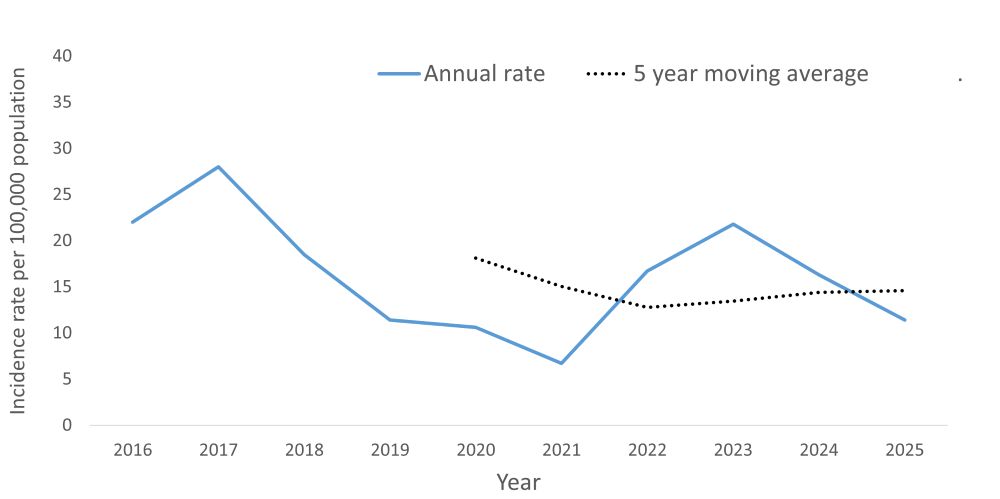
17*
Incidence rate per 100,000 in 2025: 11.4
*Includes confirmed cases in 2025.
Incidence rate per 100,000 of salmonellosis by year
More information about salmonellosis
Report to the Health Unit within one business day by fax (705-482-0670) or phone at 705-474-1400 or toll free at 1-800-563-2808, ext. 5229 if salmonellosis is suspected or confirmed as per Ontario Regulation 135/18 and amendments under the Health Protection and Promotion Act, R.S.O., c.H.7.
Should one go to childcare, school, or work if they have salmonellosis?
Exclude symptomatic food handlers, childcare workers and attendees, and anyone caring for high-risk individuals (e.g., elderly or those with a weakened immune system) until symptom free for 24 hours or symptom free for 48 hours after discontinuing use of anti-diarrheal medication. This is to ensure diarrhea does not return after the anti-diarrheal medication has been stopped. If antibiotics are used, the person should be excluded until symptom free for 24 hours. If a relapse occurs, exclude again, and seek medical attention as needed.
Follow the direction of your healthcare provider, public health case manager, or occupational health at your workplace.
Healthcare provider information
Treatment depends on the clinical symptoms presented by the patient. See Public Health Agency of Canada, For health professionals: Salmonellosis - Treatment.
Infection prevention and control
Routine practices are recommended for adult patients with Salmonellosis. Contact precautions are recommended for paediatric and incontinent or non adherent adults until stools are formed. See Best Practices for Routine Practices and Additional Precautions for additional information.
At Public Health Ontario, primary testing of clinical specimens for enteric bacteria is restricted to local health unit requests for case management and cluster/outbreak investigations only. Refer to Enteric Bacteria (including Salmonella, Shigella, STEC, Plesiomonas, Yersinia, Aeromonas, Vibrio, or Campylobacter) – Culture and PCR for additional information.
Public Health Ontario:
Contact our Communicable Disease Control (CDC) program at 705-474-1400 or toll free at 1-800-563-2808, ext. 5229, or by email to cdc@healthunit.ca for more information.
Last updated: June 2026, by CDC