
- Case counts (2016-2025), population estimates (2016-2023), & population projections (2024-2025): Public Health Ontario.
- Query: Case counts of reportable diseases by public health unit and year. Toronto, ON: Ontario Agency for Health Protection and Promotion; extracted on March 9, 2026.
Haemophilus Influenzae
Haemophilus influenzae (Hi) disease is caused by bacteria. The illness can range from mild to severe. Despite its name, Haemophilus influenzae has nothing to do with the influenza virus (flu). Typically, Haemophilus influenzae bacteria cause a mild infection, but severe infection can occur when the bacteria get into parts of the body where they are not usually found. This includes the bloodstream and brain. This type of infection causes invasive Haemophilus influenzae disease. There are several types of Hi bacteria. Type b (known as Hib) can cause serious and life-threatening illness.
Local Information
2025 Statistics
Incidence rate is the number of new cases of disease divided by the number of persons at risk for the disease during a particular time period.
Cases:
2*
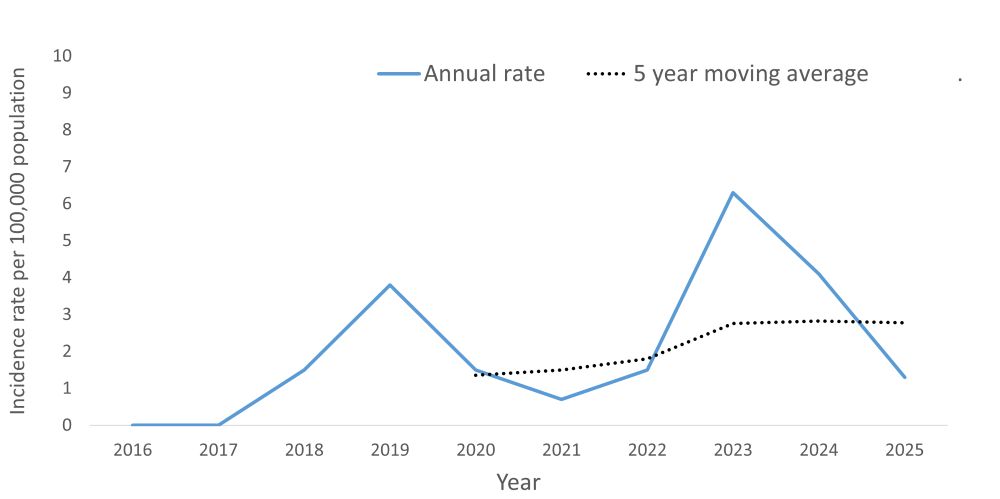
Incidence rate per 100,000 in 2025: 1.3
*Includes confirmed and probable cases in 2025.
Incidence rate per 100,000 of haemophilus influenzae disease, all types, invasive by year
More information about haemophilus influenzae
Public Health Agency of Canada:
Report to the Health Unit immediately by fax (705-482-0670) and phone at 705-474-1400 or toll free at 1-800-563-2808, ext. 5229 if Haemophilus influenzae is suspected or confirmed as per Ontario Regulation 135/18 and amendments under the Health Protection and Promotion Act, R.S.O., c.H.7.
After hours, weekends, and holidays, call 705-474-1400 then press 0 to speak with the Answering Service. The on-call CDC Public Health Nurse will get back to you as soon as possible.
Should one go to childcare, school, or work if they have haemophilus influenzae?
Exclude until treatment has been taken for 48 hours.
Follow the direction of your healthcare provider, public health case manager, or occupational health at your workplace.
Haemophilus influenzae is preventable by vaccination. Check your vaccination records or call the Vaccine Preventable Diseases program at 705-474-1400 or toll free at 1-800-563-2808, ext. 5252 to book a vaccination appointment or to obtain additional information.
Healthcare provider information
In Ontario, individuals are immunized with haemophilus influenzae type b (Hib) containing vaccines beginning in infancy. Refer to the Publicly Funded Immunization Schedules for Ontario for information on eligibility and timing of publicly funded vaccines. Refer to Haemophilus influenzae type B (Hib) vaccines: Canadian Immunization Guide for detailed information on Hib-containing vaccine.
Invasive Haemophilus influenzae is treated with antibiotics. Cases of Haemophilus influenzae type b who are less than two years of age or who are a member of a household with susceptible contacts should additionally receive rifampin chemoprophylaxis prior to hospital discharge if cefotaxime or ceftriaxone were not used for treatment. Refer to Ministry of Health Infectious Disease Protocol, Appendix 1: Haemophilus influenzae, all types, invasive for additional information.
Infection prevention and control
Droplet precautions are recommended for 24 hours after initiation of antimicrobial therapy for hospitalized cases of Haemophilus influenzae type B.
Public Health Ontario performs confirmation of identification and serotyping of Haemophilus influenzae isolates. Refer to Haemophilus influenzae – Confirmation of Identification and Serotyping for additional information.
Post-exposure prophylaxis (PEP) - applies only to contacts of invasive Haemophilus influenzae type B
PEP for contacts exposed to a case of invasive Haemophilus influenzae type B disease
A contact is defined as a person living with or who has spent four or more hours per day with the case, for at least five of the seven days preceding the day of hospital admission of the case.
Recommended PEP Options:
- Chemoprophylaxis is recommended for:
- All members in households:
- With at least one contact under four years of age who is unimmunized or incompletely immunized
- With a child less than 12 months of age who has not received the primary series, and
- With an immunocompromised child, regardless of that child’s Hib immunization status.
- For Childcare settings:
- If one case of Hib disease has occurred, chemoprophylaxis should be provided to incompletely on unimmunized children younger than four years of age; and
- If two or more cases of invasive Hib disease have occurred within 60 days and unimmunized or incompletely immunized children attend the facility, chemoprophylaxis for all attendees and childcare providers should be considered.
- All members in households:
Exposed children who develop a febrile illness should promptly see their healthcare provider for evaluation.
Vaccination is recommended for:
- all contacts who are young children and who have not been completely immunized against Hib or are not immunized at the recommended age-appropriate intervals
- vaccine series completion and administration at the recommended intervals is essential to achieve optimal protection against invasive Hib disease
Public Health Agency of Canada:
Contact our Communicable Disease Control (CDC) program at 705-474-1400 or toll free at 1-800-563-2808, ext. 5229, or by email to cdc@healthunit.ca for more information.
Last updated: Apr 2026, by CDC