
- Case counts (2016-2025), population estimates (2016-2023), & population projections (2024-2025): Public Health Ontario.
- Query: Case counts of reportable diseases by public health unit and year. Toronto, ON: Ontario Agency for Health Protection and Promotion; extracted on March 9, 2026.
Severe Acute Respiratory Syndrome
SARS
Severe acute respiratory syndrome (SARS) is a viral respiratory disease caused by SARS-CoV-1, a respiratory virus that can spread through the air through small infectious respiratory particles.
SARS can also be transmitted indirectly through surfaces contaminated with the virus by someone who is infected. SARS cases were detected as early as November 2002 as part of an outbreak that emerged in China and subsequently spread to 28 other countries, including Canada.
There have been no known cases of SARS anywhere in the world since 2004.
Local Information
2025 Statistics
Incidence rate is the number of new cases of disease divided by the number of persons at risk for the disease during a particular time period.
Cases:
0*
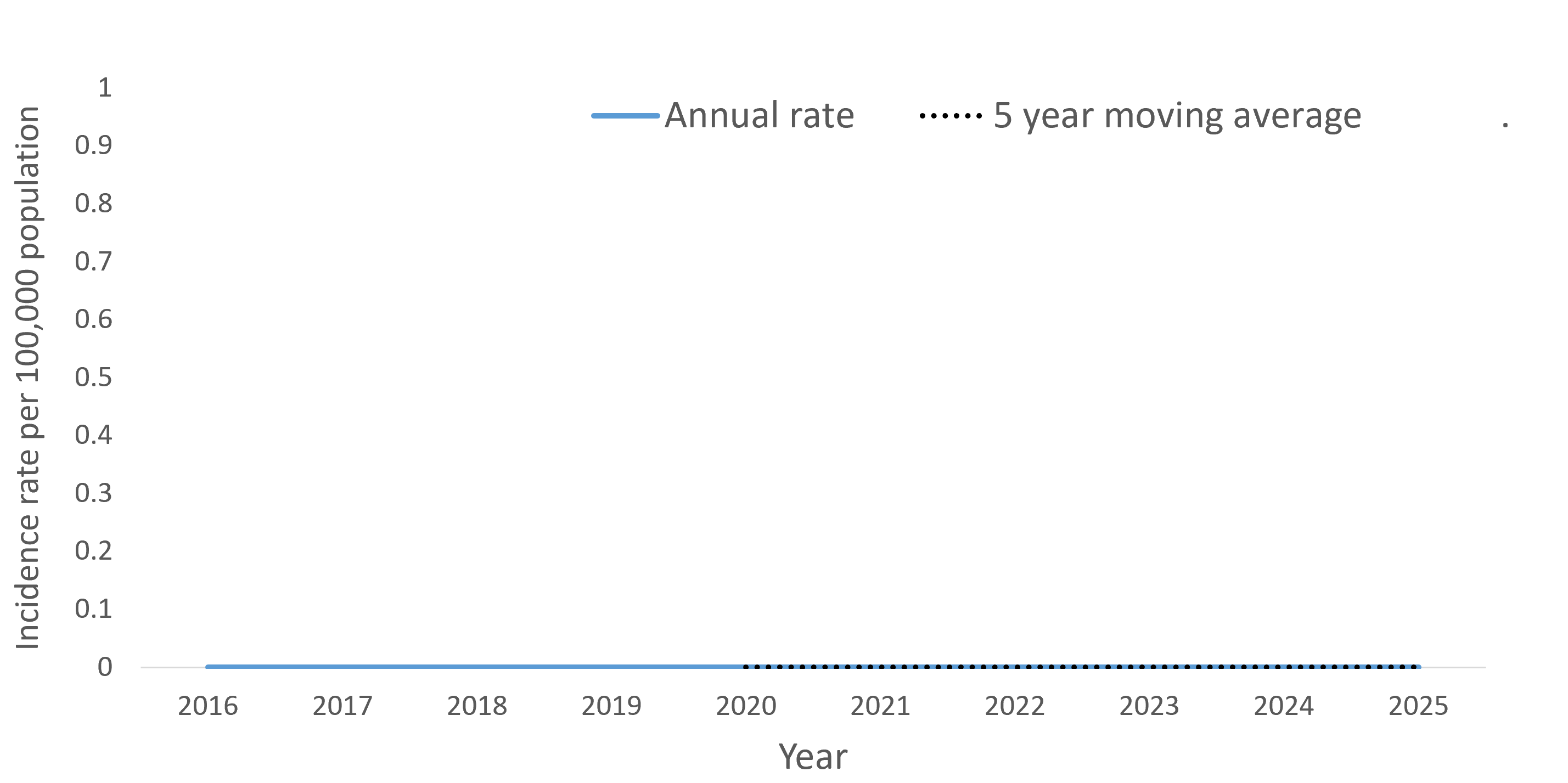
Incidence rate per 100,000 in 2025: 0
*Includes confirmed cases in 2025.
Incidence rate per 100,000 of severe acute respiratory syndrome (SARS) by year
Canadian Centre for Occupational Health and Safety:
Report to the Health Unit immediately by fax (705-482-0670) and phone at 705-474-1400 or toll free at 1-800-563-2808, ext. 5229 if SARS is suspected or confirmed as per Ontario Regulation 135/18 and amendments under the Health Protection and Promotion Act, R.S.O., c.H.7.
After hours, weekends, and holidays, call 705-474-1400 then press 0 to speak with the Answering Service. The on-call CDC Public Health Nurse will get back to you as soon as possible.
Should one go to childcare, school, or work if they have SARS?
Exclude and self-isolate while ill and do not go to work, school, or other public areas until symptoms have resolved and feeling well enough to participate in regular activities.
The Health Unit will be actively monitoring people who have been diagnosed with SARS and will tell them when to stop isolating.
Healthcare provider information
Common early illness includes two or more of fever (>38 degrees Celsius), chills, rigors, myalgia, headache, sore throat, or rhinorrhea. Mild to moderate respiratory illness includes fever and one or more clinical findings of lower respiratory illness (e.g., cough, shortness of breath, and breathing difficulties).
In severe cases, infection can progress to illnesses such as pneumonia, acute respiratory distress syndrome (ARDS), severe influenza-like illness, kidney failure, and even death.
If SARS Coronavirus (SARS CoV-1) is suspected contact the Public Health Ontario laboratory to consult with a microbiologist. Refer to Public Health Ontario: SARS - RT-PCR for additional information.
Infection prevention and control
Healthcare providers should wear appropriate PPE based on their point of care risk assessment when assessing patients with suspect acute respiratory infections. Proper use of infection prevention and control measures such as hand hygiene, isolation procedures and appropriate use of PPE is always encouraged.
Refer to Infection Prevention and Control (IPAC) Canada: SARS-CoV, Infection Control Precautions, for more information.
Infection Prevention and Control (IPAC) Canada:
Contact our Communicable Disease Control (CDC) program at 705-474-1400 or toll free at 1-800-563-2808, ext. 5229, or by email to cdc@healthunit.ca for more information.
Last updated: July 2026, by CDC