
- Case counts (2016-2025), population estimates (2016-2023), & population projections (2024-2025): Public Health Ontario.
- Query: Case counts of reportable diseases by public health unit and year. Toronto, ON: Ontario Agency for Health Protection and Promotion; extracted on March 9, 2026.
Tularemia
Tularemia is a rare disease caused by the bacteria Francisella tularensis. Wild animals, especially rabbits and some domestic animals are reservoirs (a place where the bacteria can live and reproduce) for the bacteria. The disease is spread to humans through the bite of ticks or deer flies, or through handling infected animal carcasses.
Local Information
2025 Statistics
Incidence rate is the number of new cases of disease divided by the number of persons at risk for the disease during a particular time period.
Cases:
0*
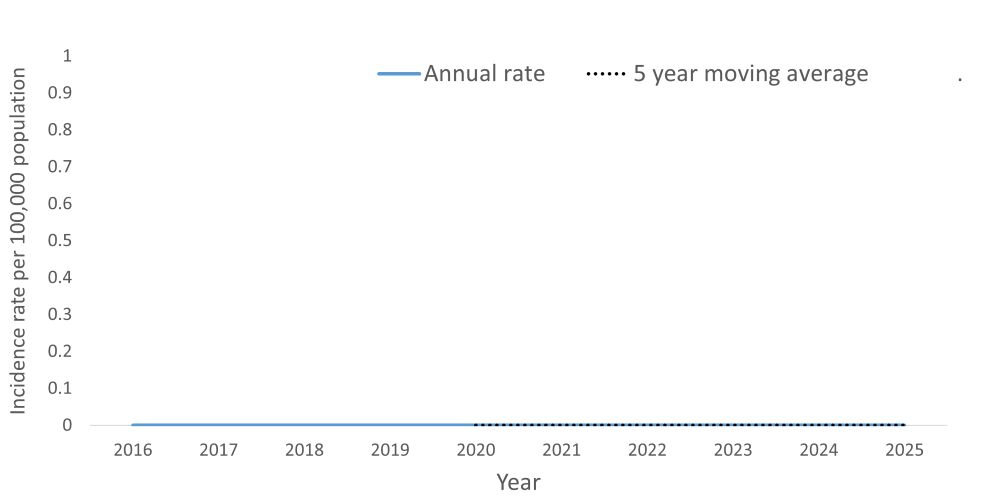
Incidence rate per 100,000 in 2025: 0
*Includes confirmed cases in 2025.
Incidence rate per 100,000 of tularemia by year
More information about tularemia
U.S. Centers for Disease Control and Prevention:
Report to the Health Unit within one business day by fax (705-482-0670) or phone at 705-474-1400 or toll free at 1-800-563-2808, ext. 5229 if tularemia is suspected or confirmed as per Ontario Regulation 135/18 and amendments under the Health Protection and Promotion Act, R.S.O., c.H.7.
Should one go to childcare, school, or work if they have tularemia?
No excursion necessary as it is not spread from person to person, unless too ill to participate in regular activities.
Healthcare provider information
Infection prevention and control
No person-to-person transmission has been reported. Routine practices are recommended. See Public Health Ontario: Clinical Syndromes/Conditions with Required Level of Precautions in Best Practices for Routine Practices and Additional Precautions for additional information.
Specific treatment is under the direction of the attending health care provider. Treatment mainly involves administration of antibiotics. Refer to Pathogen Safety Data Sheets: Infectious Substances – Francisella tularensis for more information.
Canadian Centre for Occupational Health and Safety:
Public Health Ontario:
Ministry of Health:
Contact our Communicable Disease Control (CDC) program at 705-474-1400 or toll free at 1-800-563-2808, ext. 5229, or by email to cdc@healthunit.ca for more information.
Last updated: July 2026, by CDC