
- Case counts (2016-2025), population estimates (2016-2023), & population projections (2024-2025): Public Health Ontario.
- Query: Case counts of reportable diseases by public health unit and year. Toronto, ON: Ontario Agency for Health Protection and Promotion; extracted on March 9, 2026.
Tetanus
Lockjaw
Tetanus (lockjaw) is caused by the bacteria Clostridium tetani. The spores are commonly found in soil, dust, and stool. A person can become infected with tetanus when the spores enter the body through broken skin such as a puncture wound, cut, animal bite, or burn. Tetanus is characterized by muscle spasms, seizures, fever, and may result in death.
Local Information
2025 Statistics
Incidence rate is the number of new cases of disease divided by the number of persons at risk for the disease during a particular time period.
Cases:
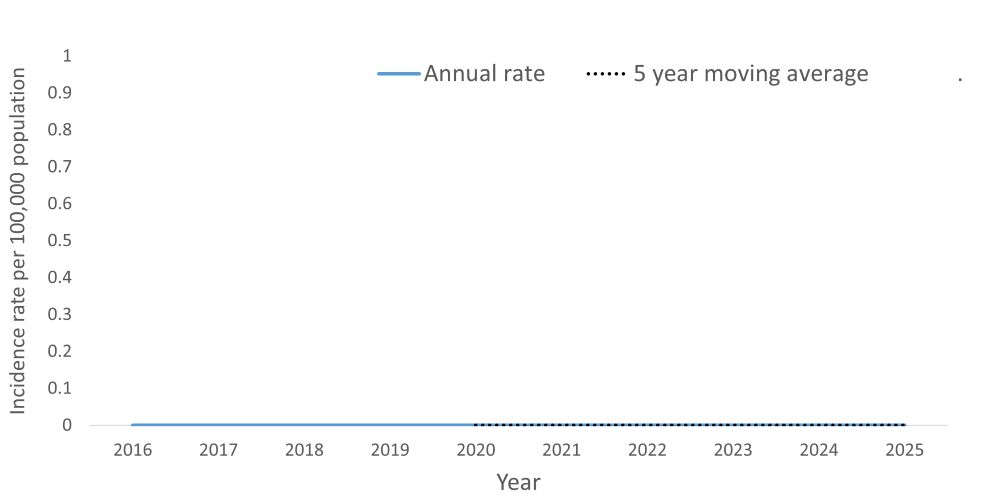
0*
Incidence rate per 100,000 in 2025: 0
*Includes confirmed cases in 2025.
Incidence rate per 100,000 of tetanus by year
More information about tetanus
Public Health Agency of Canada
Ministry of Health
Report to the Health Unit within one business day by fax (705-482-0670) or phone at 705-474-1400 or toll free at 1-800-563-2808, ext. 5229 if tetanus is suspected or confirmed as per Ontario Regulation 135/18 and amendments under the Health Protection and Promotion Act, R.S.O., c.H.7.
Should one go to childcare, school, or work if they have tetanus?
No exclusion necessary as it is not spread person to person, unless too ill to participate in regular activities.
Tetanus is preventable by vaccination. Check your vaccination records or call the Vaccine Preventable Diseases program at 705-474-1400 or toll free at 1-800-563-2808, ext. 5252 to book a vaccination appointment or to obtain additional information.
Healthcare provider information
Tetanus is preventable by vaccination. Refer to the Publicly Funded Immunization Schedules for Ontario for details on immunization schedules and eligibility criteria for Ontario’s publicly funded immunization program. Refer also to the Tetanus toxoid chapter of the Canadian Immunization Guide for more information on Tetanus toxoid-containing vaccines.
Testing for Tetanus is not done for immunity/acute diagnosis/pre-vaccination screening and is only available for the rare event of an adverse reaction to Tetanus vaccine or the possibility of humoral immunodeficiency in the patient. This must be indicated on the test requisition for the testing to be performed. See Public Health Ontario: Tetanus – Serology for additional information.
Infection prevention and control
Tetanus is not transmitted person-to-person. Routine practices are recommended for hospitalized cases.
Treatment should be administered as per the attending health care provider. For further guidance please refer to the current Canadian Immunization Guide: Tetanus toxoid chapter.
Post-exposure prophylaxis (PEP)
It is important to ascertain the number of doses of tetanus toxoid-containing vaccine that an injured person previously has received, any severe reaction that they have experienced with a previous dose, and the interval since the last dose. Refer to Table 1: Guide to tetanus prophylaxis in wound management for guidelines for post-exposure prophylaxis.
Persons who have recovered from tetanus disease should receive tetanus toxoid-containing vaccine as recommended for people who have not had the disease. Recovery from tetanus disease does not confer immunity.
Public Health Agency of Canada:
Public Health Ontario:
Contact our Communicable Disease Control (CDC) program at 705-474-1400 or toll free at 1-800-563-2808, ext. 5229, or by email to cdc@healthunit.ca for more information.
Last updated: July 2026, by CDC