
- Case counts (2016-2025), population estimates (2016-2023), & population projections (2024-2025): Public Health Ontario.
- Query: Case counts of reportable diseases by public health unit and year. Toronto, ON: Ontario Agency for Health Protection and Promotion; extracted on March 9, 2026.
Hantavirus Pulmonary Syndrome
Hantaviruses are a group of viruses that can make people very sick. Different types of hantaviruses exist worldwide, and each causes a different illness. The two most common diseases from a hantavirus infection are hantavirus pulmonary (lung) syndrome (found in North and South America) and haemorrhagic fever with renal (kidney) syndrome (found mainly in Europe and Asia).
To prevent these diseases, it's important to keep rodents away from your home, work, and vacation spots. Always clean and disinfect areas where rodents have been, as their droppings and urine can be harmful. If you have been around rodents or their waste and start to feel sick (symptoms), see a doctor right away. Be sure to tell them you've had contact with rodents.
Local Information
2025 Statistics
Incidence rate is the number of new cases of disease divided by the number of persons at risk for the disease during a particular time period.
Cases:
0*
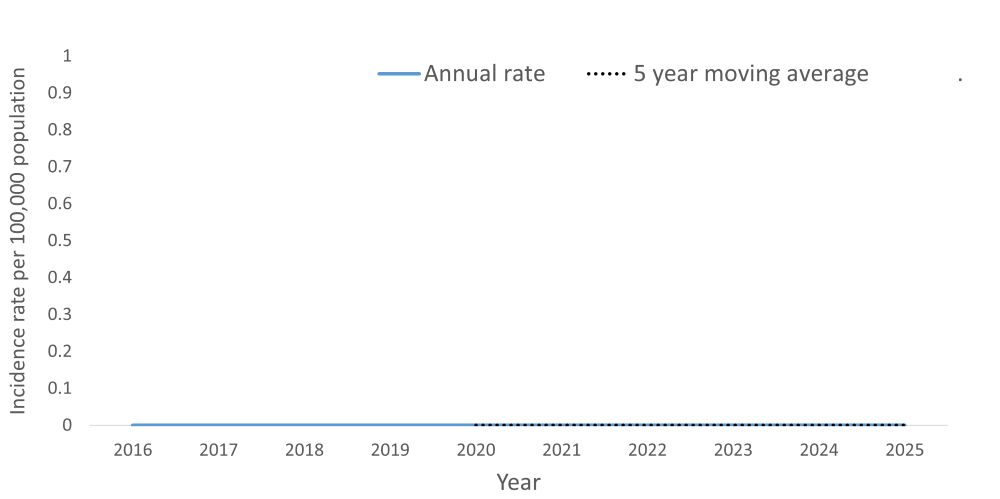
Incidence rate per 100,000 in 2025: 0
*Includes confirmed cases in 2025.
Incidence rate per 100,000 of hantavirus pulmonary syndrome by year
More information about hantavirus pulmonary syndrome
Public Health Agency of Canada:
Report to the Health Unit immediately by fax (705-482-0670) and phone at 705-474-1400 or toll free at 1-800-563-2808, ext. 5229 if hantavirus pulmonary syndrome is suspected or confirmed as per Ontario Regulation 135/18 and amendments under the Health Protection and Promotion Act, R.S.O., c.H.7.
After hours, weekends, and holidays, call 705-474-1400 then press 0 to speak with the Answering Service. The on-call CDC Public Health Nurse will get back to you as soon as possible.
Should one go to childcare, school, or work if they have hantavirus pulmonary syndrome?
No exclusion necessary as it does not spread person-to-person.
No person-to-person spread has been documented in North America.
Healthcare provider information
Treatment of hantavirus infections is generally supportive. Early recognition of disease is critical.
Infection prevention and control
In cases involving hospitalization, routine practices are recommended. Refer to the Provincial Infectious Diseases Advisory Committee (PIDAC) Routine Practices and Additional Precautions in All Health Care Settings, 3rd Edition.
Hantavirus (Andes Virus) requires additional precautions in addition to routine practices, including airborne, droplet and contact precautions.
Refer to Public Health Ontario, At a Glace - Infection Prevention and Control Precautions for Hantavirus (Andes Virus).
Serologic testing is the preferred method for hantavirus testing, however, PCR may be useful in the early acute stage of infection. Both tests should be requested for individuals with acute signs/symptoms of infection.
Testing is not indicated for asymptomatic individuals.
A clinical risk assessment for hantavirus infection, with specific evaluation of epidemiologic factors and exposure history, is recommended before submitting a test request.
For additional information on testing, refer to Public Health Ontario's Laboratory Service Test Information Index.
Public Health Agency of Canada:
Public Health Ontario:
Ministry of Health – Ontario Public Health Standards:
Contact our Communicable Disease Control (CDC) program at 705-474-1400 or toll free at 1-800-563-2808, ext. 5229, or by email to cdc@healthunit.ca for more information.
Last updated: Aug 2026, by CDC