
Any microorganism that can cause infection. This can be a bacterium, virus, parasite, fungus or prion.
Understanding the Spread of Infection
Infections are illnesses that are caused by germs (microorganisms) such as bacteria, viruses, fungi, and parasites. For an individual to get an infection, a process involving six components must occur. This process is called the chain of transmission. The goal of infection prevention and control practices is to break a link in the chain of transmission to prevent the transfer of microorganisms.
Chain of Transmission Components (links):
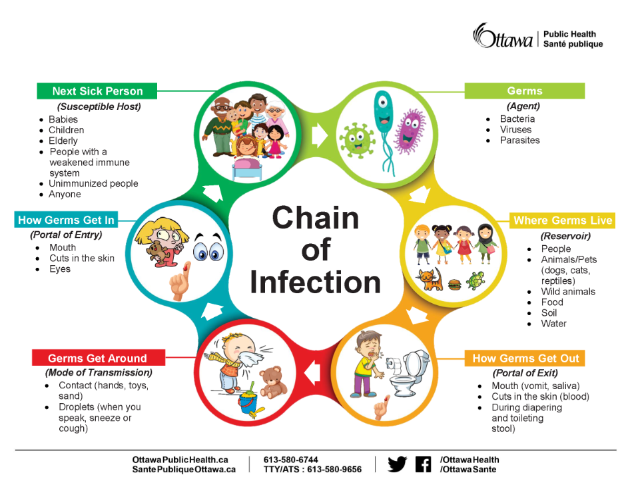
Any place that an infectious agent can live and reproduce. This can include people, contaminated food or water, insects, or animals.
The way the infectious agent leaves the reservoir. This can occur through the mouth and nose (e.g., coughing or sneezing), gastrointestinal tract excretions (e.g., vomiting or diarrhea), blood, or drainage from wounds.
The way the infectious agent travels.
This can be through:
- Direct contact from one person to another (i.e., touching), or indirect contact (i.e., from one person to an object or surface and then to another person).
- Droplets when a person coughs or sneezes.
- The air (airborne) when extremely small particles are released from one person and then inhaled by another person.
The way an infectious agent enters a susceptible host. The individual may breathe it in, touch their eyes, nose or mouth, or eat or drink contaminated food or water. The infectious agent may also enter through breaks in the skin.
Any person who is at risk of developing an infection. The individual risk will depend on the infectious agent and personal factors such as age, immune system function, and vaccination history, among others.
Breaking a link in the chain of transmission
Breaking any link in the chain of transmission will stop the transmission of the infectious agent and stop the spread of infection.
Ways to stop the spread of infection include:
- Frequent hand washing
- Receive your recommended vaccinations
- Stay home when you are sick
- Cover your coughs and sneezes
- Clean and disinfect frequently touched surfaces and objects
- Proper food preparation and storage
- Water treatment
- Treatment with antimicrobials, when appropriate
- Ottawa Public Health. (2024). Chain of Infection. Retrieved from Ottawa Public Health website.
- Provincial Infectious Disease Advisory Committee (2012). Routine Practices and Additional Precautions in All Health Care Settings. Toronto, Canada: Queen's Printer for Ontario
- Public Health Ontario. (2020). IPAC Core Competencies - Risk Assessment and Chain of Transmission.
Contact the Communicable Disease Control (CDC) program at 705-474-1400 or toll free at 1-800-563-2808, ext. 5229, or by email to cdc@healthunit.ca for more information.
Last updated: Sept 2025, by CDC