
- Case Counts: Public Health Ontario. Query: Case counts of reportable diseases by public health unit and year. Toronto, ON: Ontario Agency for Health Protection and Promotion; extracted on January 16, 2025.
- Population estimates: Statistics Canada 2014-2022, IntelliHEALTH Ontario, Ministry of Health, extracted on April 23, 2024.
- Population projections: Statistics Canada, 2023, IntelliHEALTH Ontario, Ministry of Health, extracted on April 23, 2024.
Mpox
Mpox is caused by the monkeypox virus, which is closely related to the virus that causes smallpox. While most people get better quickly, some people can become very sick. It can spread through close physical contact with someone who has mpox, or by touching contaminated surfaces.
Locally, the risk of getting mpox is low.
Local information
2024 Statistics
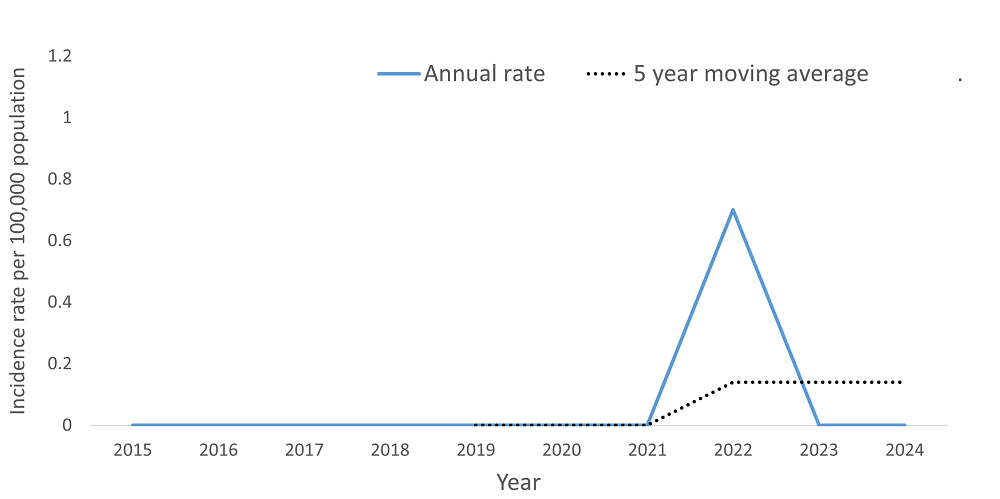
Incidence rate is the number of new cases of disease divided by the number of persons at risk for the disease during a particular time period.
Cases:
0*
Incidence rate per 100,000 in 2024: 0
*Includes confirmed cases in 2024.
Incidence rate per 100,000 of Mpox by year
- Symptoms
- Treatment
- Caring for someone with mpox or with symptoms that may be due to mpox infection
- If you have mpox
- Recommendations on hand and environmental hygiene
- Mpox in animals
- Mpox (monkeypox) fact sheet
- Mpox: What we know (Gay Men's Sexual Health Alliance)
More information from the Ontario Ministry of Health: English and Français
More information from the Public Health Agency of Canada: English and Français
Contact your healthcare provider or call our Sexual Health Clinic at 705-474-1400 or toll- free at 1-800-563-2808, ext. 5289 to get tested as soon as possible.
If you test positive for mpox at any location, you will be contacted by a Health Unit staff member, who will walk you through the next steps.
You can get tested based on a combination of factors, such as signs and symptoms and risk factors, including exposure to a case or travel history.
Symptoms of mpox can appear similar to other infectious diseases, such as chickenpox, bacterial skin infections, or sexually transmitted infections like herpes, syphilis, chlamydia, or gonorrhea.
See also:
For general mpox inquiries, or if you're not sure whether or not you have been exposed, please contact our Communicable Disease Control (CDC) program at 705-474-1400 or toll free at 1-800-563-2808, ext. 5229, to discuss your situation further. You may also email them at cdc@healthunit.ca
Report to the Health Unit immediately by phone at 705-474-1400 or toll free at 1-800-563-2808, ext. 5229 if mpox is suspected or confirmed as per Ontario Regulation 135/18 and amendments under the Health Protection and Promotion Act, R.S.O., c.H.7.
Should one go to childcare, school, or work if they have mpox?
Contact the Health Unit. Sick individuals should self-isolate at home and follow public health recommendations until lesion scabs have fallen off and new intact skin has formed below (the amount of time this takes varies from person to person, but typically takes 2-4 weeks)
Recommendations for being absent from childcare, school, work, etc. need to be assessed on an individual case basis.
Mpox is preventable by vaccination. Check your vaccination records or call the Vaccine Preventable Diseases program at 705-474-1400 or toll free at 1-800-563-2808, ext. 5252 to book a vaccination appointment or to obtain additional information.
Eligibility
These individuals are considered at high-risk for mpox exposure and are eligible for vaccination if they have not already had mpox:
- Two-Spirit, non-binary, transgender, cisgender, intersex, or gender-queer individuals who self-identify as belonging to the gbMSM (gay, bisexual, pansexual, and other men who have sex with men) community AND who meet one or more of the following:
- Have more than one partner
- Are in a relationship where at least one of the partners has other sexual partners
- Have had a confirmed sexually transmitted infection within the last year
- Have attended venues for sexual contact (e.g., bath houses, sex clubs)
- Have had anonymous sex (e.g., using hookup apps) recently
- Sexual partners of individuals who meet the criteria above
- Sex workers (regardless of gender, sex assigned at birth, or sexual orientation) or who are a sexual contact of an individual who engages in sex work
- Staff or volunteers in sex-on-premises venues where workers may have contact with objects or materials (e.g., clothing, linens, towels, furniture, etc.) potentially contaminated with mpox
- Individuals who engage in sex tourism (regardless of gender, sex assigned at birth, or sexual orientation)
- Individuals who anticipate experiencing any of the above scenarios
Household contacts of people who fit the above criteria AND who are moderately to severely immunocompromised or who are pregnant may be at higher risk for severe illness from mpox infection and may be considered for pre-exposure vaccine.
Individuals who meet these criteria should contact our Vaccine Preventable Diseases program or their healthcare provider for more information.
If you have had close contact with an infected person or have been in a place where mpox has been identified, you are also eligible for vaccination (as long as you weren't fully vaccinated against mpox already.) The infected person can be a confirmed or probable case.
See Vaccination for Mpox for more information.
Healthcare Provider Information
- Public Health Ontario: Mpox
- Public Health Ontario: Monkeypox Virus
- Public Health Agency of Canada: Mpox (monkeypox): For Health Professionals
- Public Health Agency of Canada: Mpox Public Health Management of Cases and Contacts in Canada
- Ministry of Health: Mpox (monkeypox) Resources for Healthcare Professionals
- Ministry of Health: Recommendations for the Management of Cases and Contacts of Mpox in Ontario
- Ministry of Health: Mpox Vaccine (Imvamune®) Guidance for Healthcare Providers
- Infectious Disease Protocol, Appendix 1: Smallpox and other Orthopoxviruses including Mpox
Contact our Communicable Disease Control (CDC) program at 705-474-1400 or toll free at 1-800-563-2808, ext. 5229, or by email to cdc@healthunit.ca for more information.
Last updated: February 2025, by CDC