
- Case counts (2016-2025), population estimates (2016-2023), & population projections (2024-2025): Public Health Ontario.
- Query: Case counts of reportable diseases by public health unit and year. Toronto, ON: Ontario Agency for Health Protection and Promotion; extracted on March 9, 2026.
Measles
Measles is caused by the measles virus, a very contagious respiratory virus that can spread easily through the air when someone with measles breathes, coughs, sneezes or talks.
The illness can be more severe in children younger than five years of age, and adults over the age of 20 years, immunocompromised individuals, and susceptible pregnant individuals.
Many people fully recover from measles within two to three weeks, but some people will have complications that can include ear infection, pneumonia, diarrhea, respiratory failure, inflammation and swelling of the brain (encephalitis), blindness, deafness, or brain injury. It is also possible to develop a rare and fatal neurological condition called subacute sclerosing panencephalitis seven to ten years after recovering from measles. The risk of developing this condition may be higher if you have measles before two years of age.
Complications for people who get measles while pregnant can include miscarriage, premature labour, or giving birth to an infant with a low birth weight.
Over 90 per cent of people who aren't immune will become infected if exposed to measles. If you are infected, you can spread measles from four days before the onset of a rash to four days after a rash appears. The virus can live up to two hours in the air or on surfaces in a space where you've been.
Local Information
2025 Statistics
Incidence rate is the number of new cases of disease divided by the number of persons at risk for the disease during a particular time period.
Cases:
12*
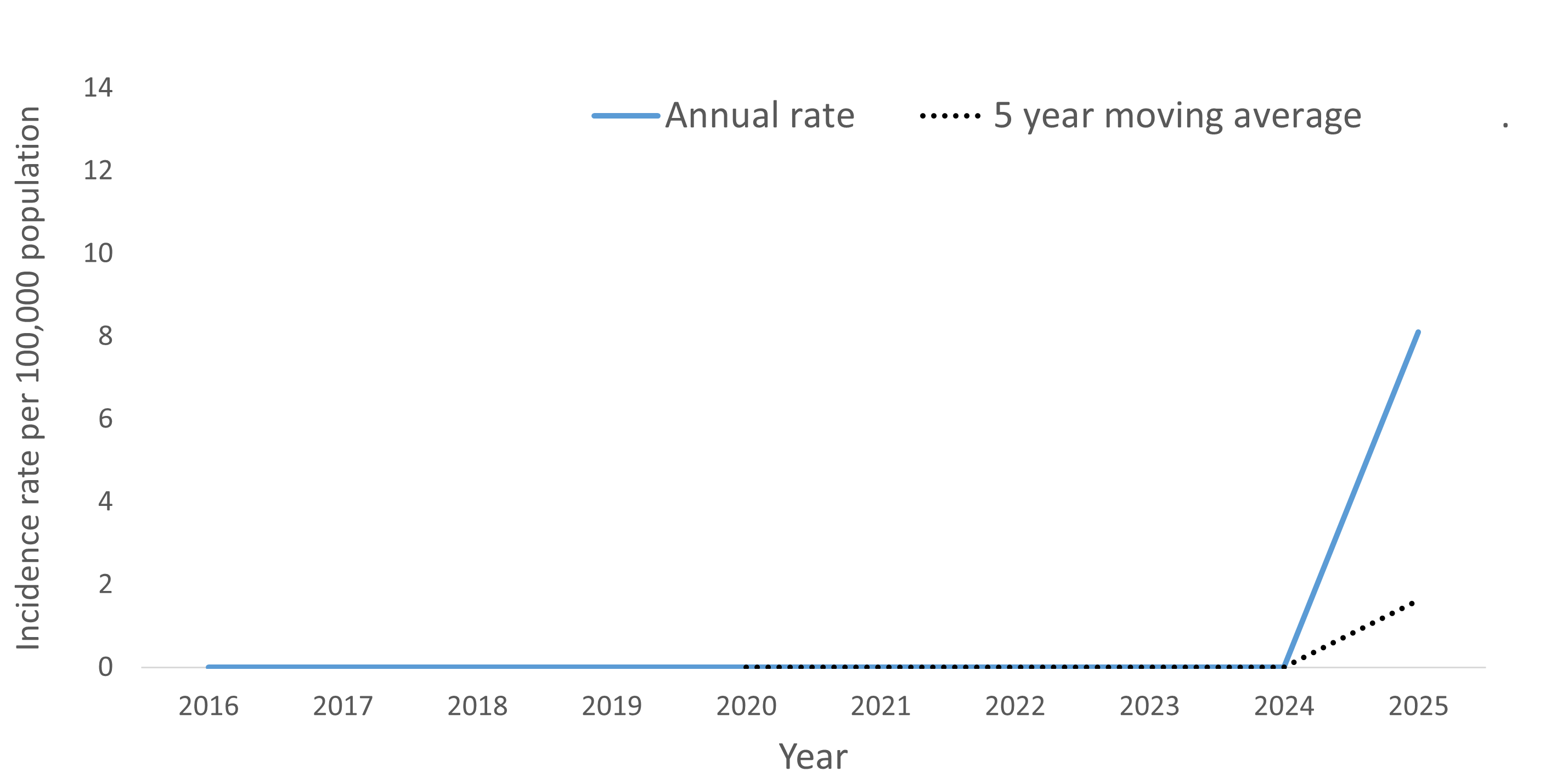
Incidence rate per 100,000 in 2025: 8.1
*Includes confirmed cases in 2025.
Incidence rate per 100,000 of measles by year
More information about measles
Public Health Agency of Canada:
Ministry of Health:
Report to the Health Unit immediately by fax (705-482-0670) and phone at 705-474-1400 or toll free at 1-800-563-2808, ext. 5229 if measles is suspected or confirmed as per Ontario Regulation 135/18 and amendments under the Health Protection and Promotion Act, R.S.O., c.H.7.
After hours, weekends, and holidays, call 705-474-1400 then press 0 to speak with the Answering Service. The on-call CDC Public Health Nurse will get back to you as soon as possible.
Should one go to childcare, school, or work if they have measles?
Exclude from work, school, childcare, and other public activities for four days from the onset of the rash and only return once well enough to participate comfortably in activities.
Follow the direction of your healthcare provider, public health case manager, or occupational health at your workplace.
Measles is preventable by vaccination. Check your vaccination records or call the Vaccine Preventable Diseases program at 705-474-1400 or toll free at 1-800-563-2808, ext. 5252 to book a vaccination appointment or to obtain additional information.
The body needs time to produce protective antibodies in response to the vaccine. People are usually fully protected after about two weeks post-vaccination. Two doses of the measles vaccine are about 97% effective at preventing measles if exposed to the virus. One dose is about 93% effective.
Adults
- If you are born before 1970, you are presumed to have natural immunity to measles
- Every adult is eligible for one dose of the MMR vaccine if they have never received one previously
- Adults who have only received one dose of the MMR vaccine are eligible to receive a second dose:
- If they are healthcare workers
- If they are post-secondary students
- If they are in the military
- If they are planning to travel to areas where disease is of concern
- Based on the healthcare provider's clinical judgment
Children
- Children should receive two doses of measles-containing vaccine:
- One dose of the MMR vaccine at one year of age (on/after the first birthday)
- One dose of the MMR vaccine (or MMR and Varicella vaccines) between four and six years of age
Infants
Protect them by getting the vaccine yourself. Infants are at the highest risk of getting measles as they are not usually given the vaccine until 12 months of age.
- Infants six to eleven months of age can be given an MMR vaccine if they have been exposed to measles (within 72 hours of exposure) or if they are going to live or travel to areas where disease is of concern. If the MMR vaccine is given at this age, it will not provide lasting protection against the virus. Two additional doses are required at ≥1 year of age and at appropriate intervals.
Healthcare Workers
Refer to Healthcare provider information section.
Healthcare provider information
Recognizing and responding to measles
Public Health Ontario:
Immunizing patients
The routine immunization schedule for measles is found in the Publicly Funded Immunization Schedules for Ontario.
Immunizing Healthcare workers
According to the Canadian Immunization Guide, all healthcare workers should be immune to measles. Regardless of birth year, the criteria for measles immunity includes:
- Documentation of vaccination with two doses of measles-containing vaccine on or after their first birthday
- OR
- Laboratory evidence of immunity
- OR
- Documentation of lab confirmed infection.
By ensuring all healthcare workers are immune to measles, your facility can reduce the possibility of staff exclusion following exposure which will help maintain adequate staffing levels and minimize disruption in patient/resident care.
Routine serologic testing to determine the immunity of healthcare workers without immunization records is generally not practical. If a healthcare worker reports incomplete immunization or lacks adequate documentation of immunization, they should be considered unimmunized and started on an immunization schedule appropriate for their age and risk factors.
Measles-containing vaccine may be given regardless of possible previous receipt of the vaccine because additional adverse events associated with repeated immunization have not been demonstrated.
Measles-susceptible healthcare workers should receive 2 doses of measles-containing vaccine (i.e., Measles Mumps Rubella vaccine), administered with a minimum interval of 4 weeks between doses.
Canadian Immunization Guide:
Immunize Canada:
Infection prevention and control
The measles virus is spread by contact with respiratory particles through inhalation or contact with mucous membranes at short and long range (e.g., airborne). These particles can remain suspended and contagious in the air for up to two hours, depending on the number of air changes. The virus can also live on surfaces for up to two hours, therefore transmission of measles via fomites is also possible.
- If the patient is suspected of measles prior to their arrival, schedule the patient visit for the end of the day to minimize exposure to others.
- Screen patients upon arrival to your health care setting for symptoms of acute respiratory illness including rash. Sample Signage for Passive Screening from Public Health Ontario’s Best Practices for the Prevention of Acute Respiratory Infection Transmission in All Health Care Settings document.
- Ensure the patient wears a medical mask (if no contraindications).
- Place the patient in an appropriate room immediately upon arrival. A single room with negative air flow (airborne infection isolation room [AIIR]) with the door closed is preferred. If an AIIR is not available, the patient should be placed in a single room with the door closed.
- Limit patient movement unless absolutely necessary. Use transport routes that minimize contact with others and clear all hallways and elevators along the route.
- Only health care workers (HCWs) with at least two doses of measles-containing vaccine or laboratory evidence of immunity, regardless of year of birth, should provide care to patients with suspect/confirmed measles.
- Measles can spread through airborne, droplet and contact transmission. Therefore, all individuals suspected of having a measles infection should be managed under airborne, droplet and contact precautions. All HCWs regardless of immunity to measles are to wear a fit-tested, seal-checked N95 respiratory, eye protection, gown and gloves when providing care to a patient with suspect or confirmed measles.
- After the patient leaves, the door to the room where the patient was examined must remain closed with signage to indicate that the room is not to be used. Do not use the room for two hours to allow for sufficient time for the air to be free of respiratory particles.
- Once sufficient time has elapsed, conduct routine cleaning and disinfection of the room and equipment. Be sure to follow the manufacturer's instructions for use of all cleaning and disinfection products, including adherence to the correct contact time.
For additional IPAC information see:
Public Health Ontario:
- Measles: Information for Health Care Providers
- Measles IPAC checklist for clinics and specimen collection centres
- Clinical Syndromes/Conditions with Required Level of Precautions
Provincial Infectious Diseases Advisory Committee (PIDAC):
Diagnostic laboratory testing is essential for all suspected measles cases. A nasopharyngeal or throat swab and urine sample for polymerase chain reaction (PCR) testing are required for diagnosis. Whole blood or serum for diagnostic serology may provide additional diagnostic value but is not required during periods of high community transmission See Measles – Diagnostic – PCR and Measles – Serology for details.
Ensure your office has specimen containers and supplies available for testing. Confirm expiry date on the specimen containers (e.g., swabs). Kits can be ordered from the Public Health Ontario Laboratory (PHOL).
Individuals who are tested for measles can be provided with the following resource: Measles Testing: A Quick Guide for Patients.
If referring a patient for diagnostic testing (e.g., hospital, another healthcare facility, laboratory) the receiving facility must be notified ahead of the patient's arrival to allow IPAC measures to be implemented to prevent exposures.
Post-exposure prophylaxis (PEP)
Post-Exposure Prophylaxis (PEP) involves the timely administration of measles, mumps, and rubella (MMR) vaccine or immunoglobulin (Ig) to susceptible individuals following measles exposure.
A measles exposure includes sharing the same room or air space for any length of time during the case’s period of communicability, including two hours after the case left the room or air space. Immunoglobulin is generally administered in hospital settings.
The goals of PEP are to lower the risk of infection and reduce the severity of illness if measles infection occurs.
Susceptible Contacts:
- Any contact born on or after January 1, 1970, excluding health care workers and military personnel*,
- Without evidence of vaccination with two valid doses of measles-containing vaccine, or
- Without laboratory evidence of prior measles infection or documentation of prior confirmed measles disease, or
- Without laboratory evidence of immunity (i.e., ‘reactive’ or ‘positive’ anti-measles IgG antibody or a previous measles antibody level of >200 mIU per ml)
- All infants under 12 months of age
- Individuals with an immunocompromising condition that makes them unlikely to have developed or maintained protective levels of anti-measles antibodies, despite previous vaccination.
- Adults born before 1970 are generally presumed to have acquired natural immunity to measles, however some of these individuals may be susceptible
- Health care workers and military personnel require documented evidence of vaccination with two valid doses of measles-containing vaccine regardless of year of birth.
For additional information see:
Public Health Ontario:
Contact our Communicable Disease Control (CDC) program at 705-474-1400 or toll free at 1-800-563-2808, ext. 5229, or by email to cdc@healthunit.ca for more information.
Last updated: Oct 2025, by CDC