
- Case counts (2016-2025), population estimates (2016-2023), & population projections (2024-2025): Public Health Ontario.
- Query: Case counts of reportable diseases by public health unit and year. Toronto, ON: Ontario Agency for Health Protection and Promotion; extracted on March 9, 2026.
Group A Streptococcal disease, invasive
iGAS
Group A streptococcus (GAS) is a bacterium that people may carry in their nose, throat or on their skin without symptoms. If GAS does cause symptoms, most of the time it only causes mild illness, including strep throat.
Occasionally the bacterium can cause more severe infections. This happens when the bacterium gets into your blood, lungs, or muscles. This is called invasive group A streptococcal infection or iGAS.
The rarest, but most serious forms of iGAS, are:
- Streptococcal toxic shock syndrome
- Necrotizing fasciitis, often called flesh-eating disease
Local Information
2025 Statistics
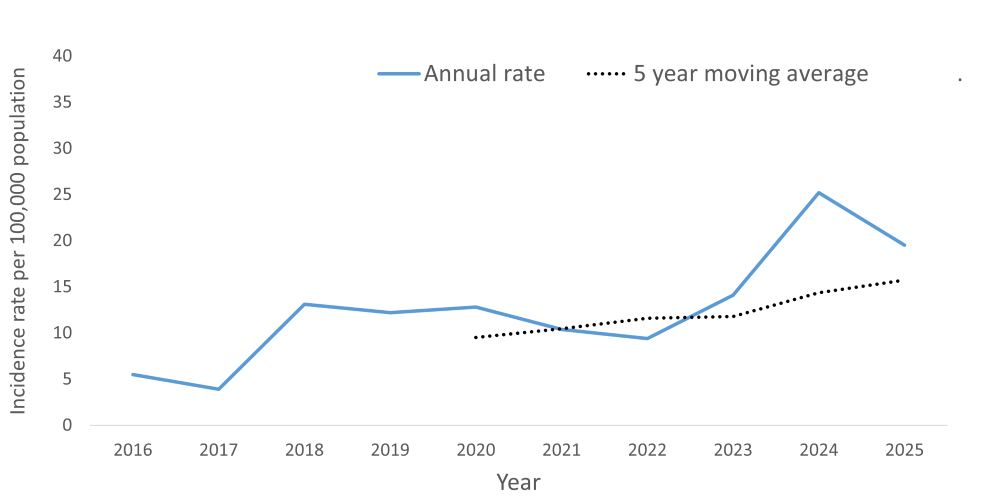
Incidence rate is the number of new cases of disease divided by the number of persons at risk for the disease during a particular time period.
Cases:
29*
Incidence rate per 100,000 in 2025: 19.5
*Includes confirmed cases in 2025.
Incidence rate per 100,000 of invasive group A streptococcal disease by year
Report to the Health Unit immediately by fax (705-482-0670) and phone at 705-474-1400 or toll free at 1-800-563-2808, ext. 5229 if iGAS is suspected or confirmed as per Ontario Regulation 135/18 and amendments under the Health Protection and Promotion Act, R.S.O., c.H.7.
After hours, weekends, and holidays, call 705-474-1400 then press 0 to speak with the Answering Service. The on-call CDC Public Health Nurse will get back to you as soon as possible.
Should one go to childcare, school, or work if they have iGAS?
Individuals with confirmed streptococcal pharyngitis, especially school-aged children, should remain at home until at least 24 hours after beginning and complying with appropriate antimicrobial therapy.
Follow the direction of your healthcare provider, public health case manager, or occupational health at your workplace.
Healthcare provider information
Antibiotics are used to treat both non-invasive and invasive GAS infections. iGAS cases must be reported to local public health, as close contacts may be eligible for post-exposure prophylaxis. More information on the management of iGAS can be found in the Guidelines for the Prevention and Control of Invasive Group A Streptococcal Disease.
Infection prevention and control
Additional precautions
Refer to the PIDAC document Routine Practices and Additional Precautions in All Health Care Settings for additional information p.88
Cleaning and disinfection
See the PIDAC document Best Practices for Environmental Cleaning for Infection Prevention and Control.
See Public Health Ontario's Laboratory Service Test Information Index.
Ministry of Health - Ontario Public Health Standards:
Public Health Agency of Canada:
Canada Communicable Disease Report:
Public Health Ontario:
Contact the Communicable Disease Control (CDC) program at 705-474-1400 or toll free at 1-800-563-2808, ext. 5229, or by email to cdc@healthunit.ca for more information.
Last updated: Apr 2026 by CDC