
- Case counts (2016-2025), population estimates (2016-2023), & population projections (2024-2025): Public Health Ontario.
- Query: Case counts of reportable diseases by public health unit and year. Toronto, ON: Ontario Agency for Health Protection and Promotion; extracted on March 9, 2026.
Echinococcus Multilocularis Infection
Echinococcus multilocularis is a small tapeworm that is normally found in canids (coyotes, foxes, and dogs), and rodents. It is primarily spread to humans through accidental consumption of contaminated stool matter of infected canids.
Important preventive measures include good hygiene practices (especially handwashing) when handling wild or domestic canid stool or after exposure to areas where wild or domestic canids may have pooped. Speak to your veterinarian about deworming options for your dogs that may be exposed to infected rodents.
Local Information
2025 Statistics
Incidence rate is the number of new cases of disease divided by the number of persons at risk for the disease during a particular time period.
Cases:
0*
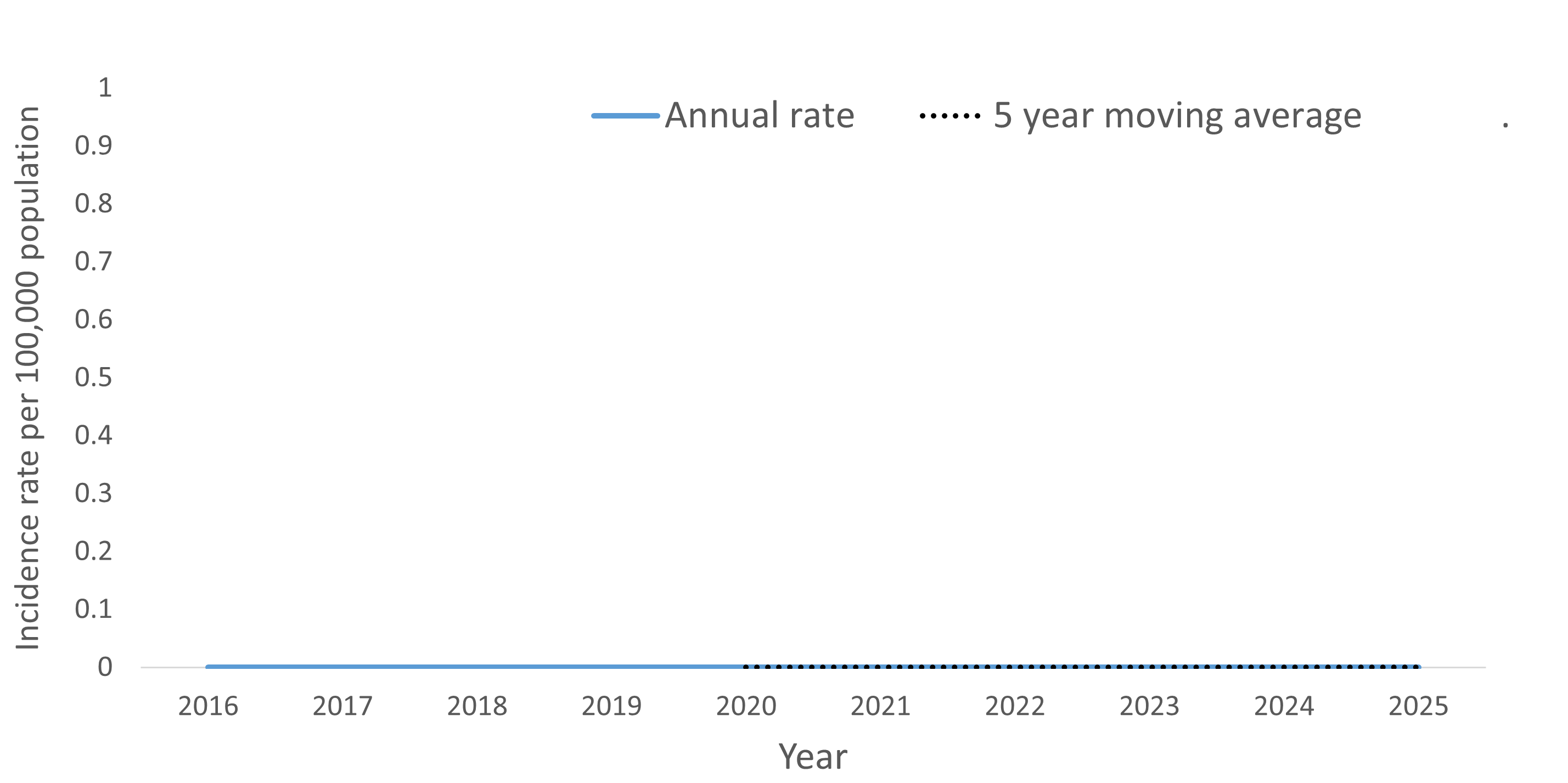
Incidence rate per 100,000 in 2025: 0
*Includes confirmed cases in 2025.
Incidence rate per 100,000 of echinococcus multilocularis infection by year
More information about echinococcus multilocularis infection
Report to the Health Unit within one business day by fax (705-482-0670) or phone at 705-474-1400 or toll free at 1-800-563-2808, ext. 5229 if echinococcus multilocularis infection is suspected or confirmed as per Ontario Regulation 135/18 and amendments under the Health Protection and Promotion Act, R.S.O., c.H.7.
Should one go to childcare, school, or work if they have echinococcus multilocularis infection?
No exclusion necessary as it is not spread from person-to-person.
Healthcare provider information
Infection prevention and control
Additional Precautions
Routine practices are recommended for hospitalized cases.
Biological samples containing living larval stages of E. multilocularis could be infective to humans if accidentally injected into a person. Therefore, precautions should be taken with regard to correct handling and disposal of needles, scalpel blades and glassware.
Cleaning and Disinfection
Regular, frequent hand hygiene after handling pets and their feces, and before handling food, can reduce the risk of transmission to humans. Areas inhabited by dogs and cats with known E. multilocularis infections should be decontaminated to prevent risk of exposure to parasitic eggs on surfaces such as pet beds, floors, carpets and car interiors.
See Public Health Ontario's Best Practices for Environmental Cleaning for Prevention and Control of Infections in All Health Care Settings.
Public Health Ontario's (PHO) laboratory performs testing for echinococcosis. See the following for additions information:
Public Health Ontario:
Ministry of Health - Ontario Public Health Standards:
Public Health Agency of Canada:
Contact our Communicable Disease Control (CDC) program at 705-474-1400 or toll free at 1-800-563-2808, ext. 5229, or by email to cdc@healthunit.ca for more information.
Last updated: Apr 2026, by CDC