
- Case counts (2016-2025), population estimates (2016-2023), & population projections (2024-2025): Public Health Ontario.
- Query: Case counts of reportable diseases by public health unit and year. Toronto, ON: Ontario Agency for Health Protection and Promotion; extracted on March 9, 2026.
Anthrax
Anthrax is an infectious disease caused by the bacteria Bacillus anthracis. It is rare in Ontario. The bacteria can be found naturally in soil, and it can infect farm animals such as cattle, sheep, and pigs. Although uncommon, a person can become infected with anthrax by contact with infected animals or exposure to contaminated animal products.
Local Information
2025 Statistics
Incidence rate is the number of new cases of disease divided by the number of persons at risk for the disease during a particular time period.
Cases:
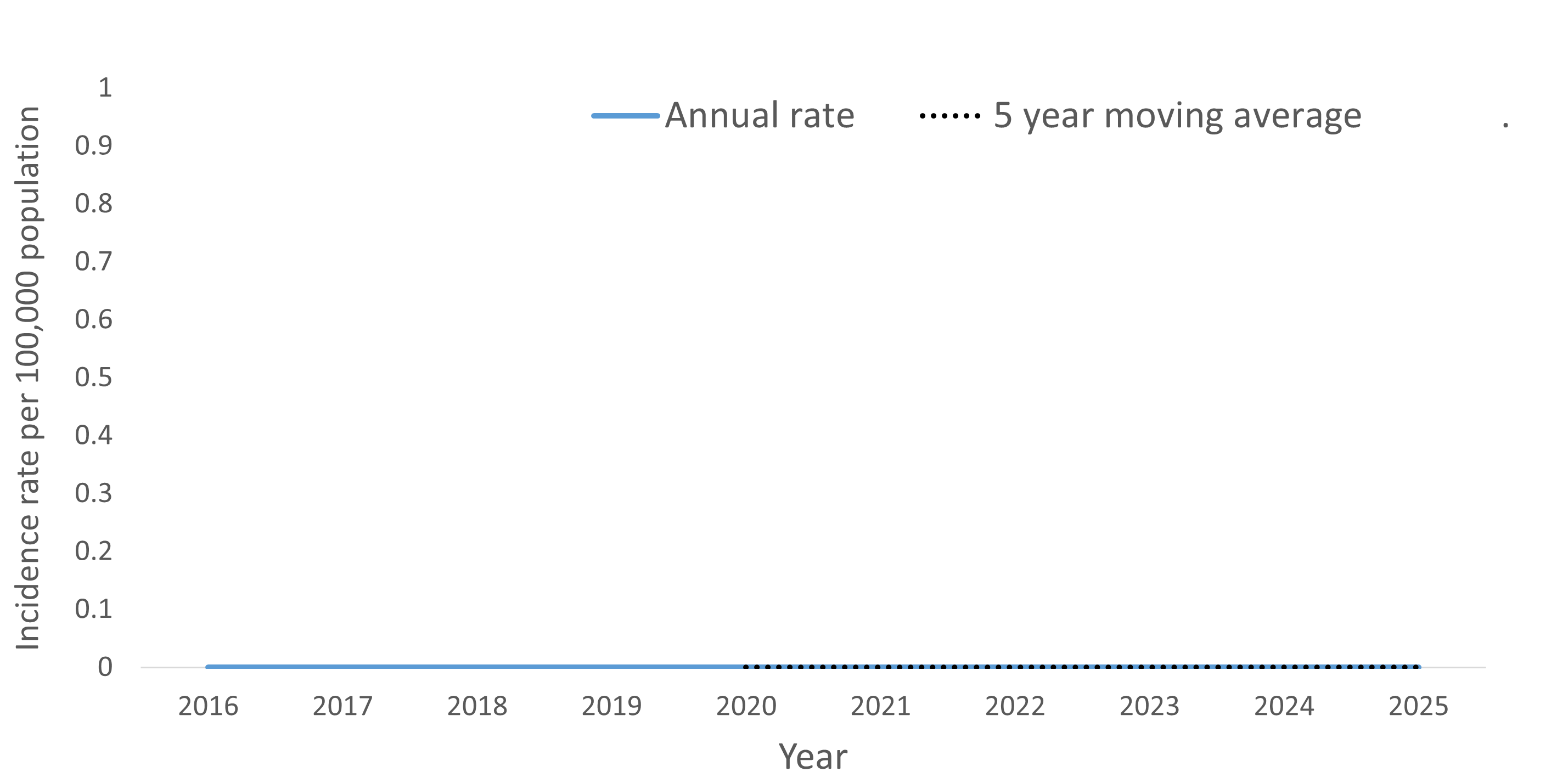
0*
Incidence rate per 100,000 in 2025: 0
*Includes confirmed cases in 2025.
Incidence rate per 100,000 of anthrax by year
More information about anthrax
Public Health Agency of Canada:
Canadian Centre for Occupational Health and Safety:
Public Health Agency of Canada:
Ministry of Health:
Report to the Health Unit immediately by fax (705-482-0670) and phone at 705-474-1400 or toll free at 1-800-563-2808, ext. 5229 if anthrax is suspected or confirmed as per Ontario Regulation 135/18 and amendments under the Health Protection and Promotion Act, R.S.O., c.H.7.
After hours, weekends, and holidays, call 705-474-1400 then press 0 to speak with the Answering Service. The on-call CDC Public Health Nurse will get back to you as soon as possible.
Should one go to childcare, school, or work if they have anthrax?
No exclusion necessary as people exposed to anthrax are not contagious.
Healthcare Provider Information
High risk individuals, such as laboratory workers and animal handlers may be immunized where indicated. Anthrax vaccine for the prevention of disease caused by Bacillus anthracis, is approved by Health Canada under Extraordinary Use New Drug Regulations, for these limited indications.
Treatment of the individual should be under the direction of an infectious disease specialist.
Any requests for the use of anthrax antitoxin (anthrax immune globulin) from the National Emergency Strategic Stockpile must be made through the Health Services Emergency Management Branch (HSEMB) of the Ministry of Health.
Infection prevention and control
Routine practices for hospitalized persons. Persons who have been exposed to anthrax are not contagious, so quarantine is not appropriate.
Persons with draining and/or open lesions should be cared for using contact precautions (gown and gloves). Dressings with drainage from lesions should be incinerated, autoclaved, or otherwise disposed of as biohazardous waste.
Post-exposure prophylaxis (PEP)
Although there is no person-to-person transmission, there could be a possibility of exposure to a common source; consultation with infectious disease experts may be prudent for decisions about the use of antibiotics for post-exposure prophylaxis.
Public Health Ontario:
Ministry of Health: Ontario Public Health Standards:
Contact our Communicable Disease Control (CDC) program at 705-474-1400 or toll free at 1-800-563-2808, ext. 5229, or by email to cdc@healthunit.ca for more information.
Last updated: Feb 2026, by CDC