
- Case Counts: Public Health Ontario. Query: Case counts of reportable diseases by public health unit and year. Toronto, ON: Ontario Agency for Health Protection and Promotion; extracted on January 16, 2025.
- Population estimates: Statistics Canada 2014-2022, IntelliHEALTH Ontario, Ministry of Health, extracted on April 23, 2024.
- Population projections: Statistics Canada, 2023, IntelliHEALTH Ontario, Ministry of Health, extracted on April 23, 2024.
Severe Acute Respiratory Syndrome (SARS)
Severe Acute Respiratory Syndrome (SARS) is caused by a previously unknown type of coronavirus. There may be factors related to the infected person's immune system or factors in the environment that affect the symptoms and severity of SARS. Normally, coronaviruses cause mild to moderate upper-respiratory symptoms, such as the common cold.
Local Information
2024 Statistics
Incidence rate is the number of new cases of disease divided by the number of persons at risk for the disease during a particular time period.
Cases:
0*
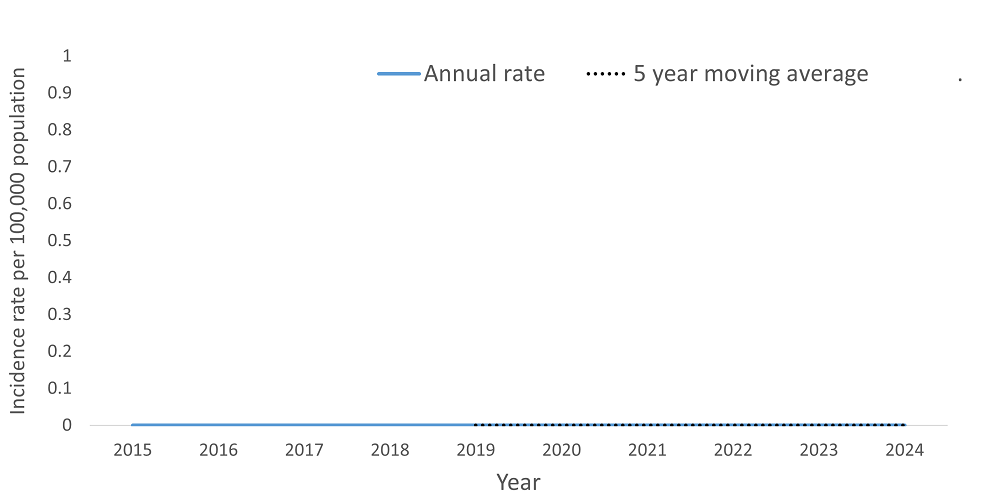
Incidence rate per 100,000 in 2024: 0
*Includes confirmed cases in 2024.
Incidence rate per 100,000 of Severe Acute Respiratory Syndrome (SARS) by year
Report to the Health Unit immediately by phone at 705-474-1400 or toll free at 1-800-563-2808, ext. 5229 if SARS is suspected or confirmed as per Ontario Regulation 135/18 and amendments under the Health Protection and Promotion Act, R.S.O., c.H.7.
Should one go to childcare, school, or work if they have SARS?
Exclude and self-isolate while ill and do not go to work, school, or other public areas until symptoms have resolved and feeling well enough to participate in regular activities. The Health Unit will be actively monitoring people who have been diagnosed with SARS and tell them when to stop isolating.
Contact our Communicable Disease Control (CDC) program at 705-474-1400 or toll free at 1-800-563-2808, ext. 5229, or by email to cdc@healthunit.ca for more information.
Last updated: February 2025, by CDC