
- Case counts (2016-2025), population estimates (2016-2023), & population projections (2024-2025): Public Health Ontario.
- Query: Case counts of reportable diseases by public health unit and year. Toronto, ON: Ontario Agency for Health Protection and Promotion; extracted on March 9, 2026.
Tuberculosis (TB)
TB Disease, TB infection, TB Medical Surveillance
Tuberculosis (TB) is a respiratory disease caused by the bacteria Mycobacterium tuberculosis. TB can be spread through the air when a person with active disease in their lungs or airways coughs, sneezes, or talks. TB usually affects the lungs, but it can affect any part of the body such as the kidneys, brain, or spine. TB is preventable, treatable, and curable with antibiotics.
Exposure to TB can also result in TB infection. Those with TB infection do not have symptoms and cannot spread TB to others.
TB Medical Surveillance is a medical check-up for a person who has newly arrived in Canada, to check that their inactive TB has not progressed to TB disease. Medical Surveillance is required for anyone who was assessed as having inactive TB on their immigration medical examination (IME). Medical Surveillance ensures that proper treatment can be provided, which in turn helps protect the health and safety of people in Canada.
Local Information
2025 Statistics
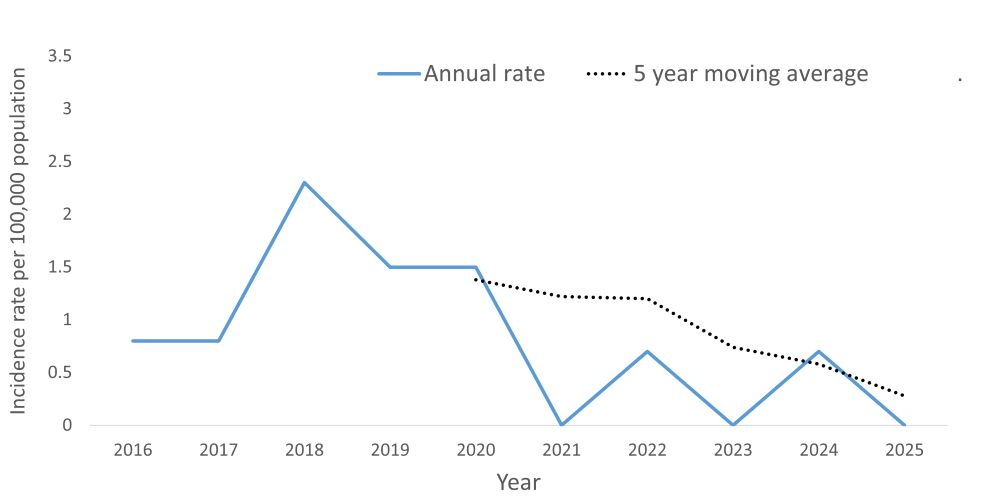
Incidence rate is the number of new cases of a disease divided by the number of persons at risk for the disease during a particular time period.
Cases:
0*
Incidence rate per 100,000 in 2025: 0
*Includes confirmed cases in 2025.
Incidence rate of 100,000 of tuberculosis by year
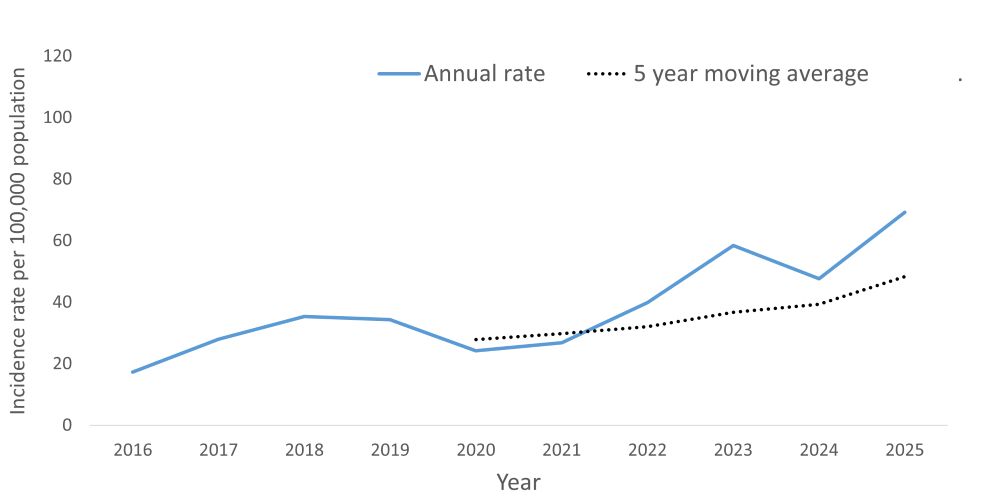
Cases:
103*
Incidence rate per 100,000 in 2025: 69.2
Cases include confirmed cases in 2025.
Incidence rate per 100,000 of tuberculosis infection by year
More information about TB disease, TB infection, and TB medical surveillance
Public Health Agency of Canada
- Tuberculosis (TB): Symptoms and treatment
- Tuberculosis (TB): Prevention and risks
- Tuberculosis (TB): Monitoring
- Tuberculosis (TB): What Canada's doing
- Tuberculosis (TB): TB medical surveillance
See TB People Canada to join a supportive community of people affected by TB.
North Bay Parry Sound District Health Unit
All TB medications are available free of charge through Public Health.
Report to the Health Unit immediately by phone at 705-474-1400 or toll free at 1-800-563-2808, ext. 5229 if TB disease is suspected or confirmed as per Ontario Regulation 135/18 and amendments under the Health Protection and Promotion Act, R.S.O., c.H.7.
To report positive Tuberculin Skin Tests (TSTs), positive Interferon Gamma Release Assays (IGRAs), and the diagnosis of TB infection, complete the Positive TST/IGRA Reporting Form and send this to the CDC program via fax to 705-482-0670.
Should one go to childcare, school, or work if they have TB disease or infection?
For TB disease, exclusion and self isolation are required. See Home Isolation fact sheet for more information. The Health Unit monitors cases of TB disease closely and will provide instructions.
For TB infection, no exclusion necessary. If symptoms of TB disease develop, seek medical attention immediately and isolate until your healthcare provider or public health case manager (public health nurse) tells you that you no longer need to isolate.
- Memo: Updates to Tuberculosis (TB) Screening Recommendations for Long-Term Care Homes and Retirement Homes in the NBPSDHU area - 2024-10-09
- TB Screening Recommendations for LTCH and RH Residents
- TB Screening Recommendations for Employees and Volunteers
- TB Risk Assessment Form Template (to download only)
Healthcare provider information
Public Health Agency of Canada:
Bacille Calmette-Guérin (BCG) vaccine is a vaccine for tuberculosis. BCG vaccine is not recommended for routine use in any Canadian population. Following consideration of local TB epidemiology and a decision that a program of early detection and treatment of TB infection cannot be implemented, BCG vaccination may be considered in exceptional circumstances, such as for infants in high risk communities, for persons at high risk of repeated exposure, for certain long term travellers to high prevalence countries, and in infants born to mothers with infectious TB disease. Refer to the Bacille Calmette-Guérin (BCG) vaccine chapter of the Canadian Immunization Guide for more information.
BCG vaccine is used in many countries in the world; the BCG World Atlas is an interactive map that provides detailed information on current and past BCG vaccination policies and practices for over 200 countries. Also see Recognizing BCG versus smallpox scars for images showing BCG versus smallpox scars.
For treatment guidelines for tuberculosis disease, see Chapter 5: Treatment of tuberculosis disease of the Canadian Tuberculosis Standards, 8th edition.
Treatment information can also be found in Chapter 7: Extra-pulmonary tuberculosis, Chapter 8: Drug-resistant tuberculosis, Chapter 9: Pediatric tuberculosis and Chapter 10, Treatment of active tuberculosis in special populations in the Canadian Tuberculosis Standards, 8th edition.
For treatment guidelines for tuberculosis infection (Tuberculosis Preventive Treatment (TPT)), see Chapter 6: Tuberculosis preventive treatment in adults of the Canadian Tuberculosis Standards, 8th edition.
An additional resource for TPT, from Public Health Ontario: Use of rifapentine and isoniazid combination therapy for the treatment of latent tuberculosis infection in Ontario.
Airborne precautions should be initiated immediately for everyone admitted to a healthcare facility with, or being evaluated for, respiratory tuberculosis. Refer to Chapter 14: Prevention and control of tuberculosis transmission in healthcare settings of the Canadian Tuberculosis Standards, 8th edition for more information.
For guidance on when to determine a case is no longer infectious of for details on when to discontinue airborne precautions, please refer to Appendix B: De-isolation review and recommendations (Canadian Tuberculosis Standards, 8th edition).
Additional IPAC Resources:
Tests for TB infection include the Tuberculin Skin Test (TST) or Interferon Gamma Release Assay (IGRA). IGRA testing is available at select LifeLabs, including Monday to Thursday (not Friday) in North Bay and other locations. It is also offered at select Dynacare labs.
The test is called Quanti-FERON® -TB Gold Plus (QFT-Plus). IGRA testing is not covered by OHIP, and the cost is approximately $104.00. Anyone seeking IGRA testing will need a laboratory requisition.
See the Tuberculin Skin Testing Guide for more information on TB disease and TB infection, how it is transmitted, symptoms, tuberculin skin testing (TST), and TB infection treatment (TPT).
See TB Skin Testing to determine who is eligible for free TST at the Health Unit.
For assistance with interpreting TST results, see The Online TST/IGRA Interpreter.
- Mycobacterium - Culture
- Mycobacterium – MTBC and Rifampin/Isoniazid Resistance PCR
- Mycobacterium – TB Susceptibility Testing
For a comparison of AFB smear results from Public Health Ontario Lab enumeration methods to those published in the Canadian Tuberculosis Standards 8th edition (Table 1: Number of bacteria seen on microscopy and laboratory interpretation of Chapter 3: Diagnosis of tuberculosis disease), refer to Acid Fast Bacilli (AFB) Smear Reports (Labstract).
To request genotyping of TB isolates, complete the TB Genotyping Request Form.
Health care coverage options for uninsured persons
TB-UP (Tuberculosis Diagnostics and Treatment Services for Uninsured Person)
The TB-UP program consists of processing payments to clinicians, laboratories, and radiology service providers for TB-related services, for treating uninsured individuals (i.e., for individuals not currently covered by the Ontario Health Insurance Plan (OHIP), Interim Federal Health (IFH), or any other provincial/territorial/private health insurance plan). The program is intended to facilitate prompt assessment, diagnosis and treatment for the uninsured individual. This will reduce the risk of transmitting TB from these persons to other Ontario residents, as well as the related costs to OHIP.
Individuals are referred to the TB-UP program by way of service provider or service agency, or by contacting the health unit directly. Application, consent, and registration for the TB-UP program is facilitated by the health unit.
Health Care Provider Claim Form – Diagnostic and Treatment Services for Uninsured Persons
Interim Federal Health Program (IFHP)
Individuals may qualify for short-term health care coverage in Canada under the Interim Federal Health Program if they are:
- A refugee (asylum) claimant
- A protected person or resettled refugee
- Part of certain other groups
In most cases individuals don’t need to apply for IFHP, their eligibility is based on their immigration status, and their health care coverage is started or cancelled automatically. See Government of Canada: Interim Federal Health Program for more information.
Work to End TB:
- Stop TB Canada
- Government of Canada's Tuberculosis Response (2025): Working towards Tuberculosis Elimination
World Health Organization: The End TB Strategy
Data and Analysis:
Public Health Ontario: Tuberculosis (TB) Epidemiological Summaries
Government of Canada Health Infobase: Tuberculosis disease surveillance
Pediatric tuberculosis:
Canadian Tuberculosis Standards, 8th edition: Chapter 9: Pediatric tuberculosis
Contact the Communicable Disease Control Program at 705-474-1400, toll free at 1-800-563-2808, ext. 5229, or by email at cdc@healthunit.ca for more information.
Last updated: April 2026, by CDC