




Q Fever is an infectious disease caused by the bacteria Coxiella burnetii. It can be found in animals such as sheep, cattle, goats, cats, and dogs. It is spread to humans by inhaling dust contaminated by infected animals’ urine, milk, stool, and other fluids or by direct contact with these contaminated items.
Local information
2025 Statistics
Incidence rate is the number of new cases of disease divided by the number of persons at risk for the disease a particular time period.
Cases:
0*
*Indicates confirmed cases in 2025
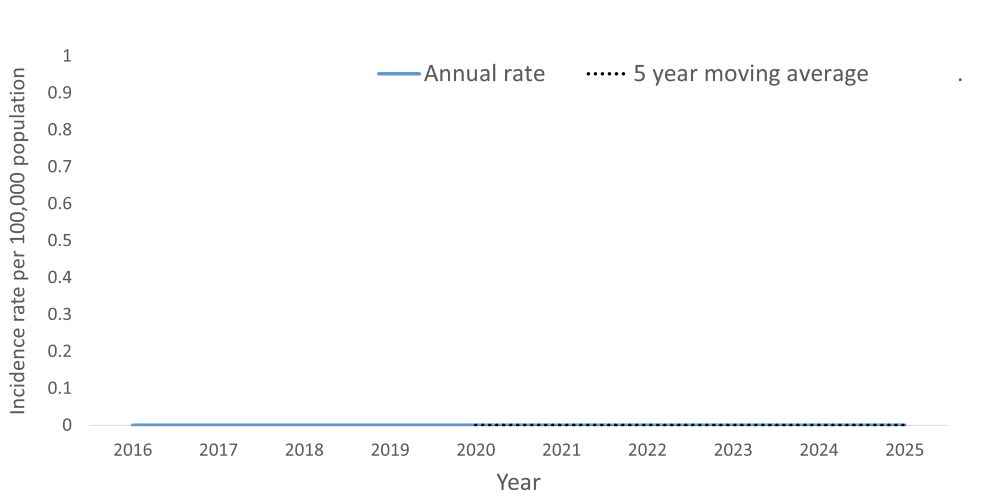
Incidence rate per 100,000 in 2025: 0
Incidence rate per 100,000 of Q fever by year
Data sources |
|
More information about Q fever |
Reporting |
|
Report to the Health Unit immediately by fax (705-482-0670) and phone at 705-474-1400 or toll free at 1-800-563-2808, ext. 5229 if Q Fever is suspected or confirmed as per Ontario Regulation 135/18 and amendments under the Health Protection and Promotion Act, R.S.O., c.H.7. After hours, weekends, and holidays, call 705-474-1400 then press 0 to speak with the Answering Service. The on-call CDC Public Health Nurse will be back to you as soon as possible. |
Should one go to childcare, school, or work if they have Q fever? |
|
No exclusion necessary unless to ill to participate in regular activities. |
Vaccine information |
|
While a vaccine is available, it is not readily available in Canada. The use of this vaccine should be limited to those at high risk of exposure whose blood tests for resistance to Q fever are negative. Check your vaccination records or call the Vaccine Preventable Diseases program at 705-474-1400 or toll free at 1-800-563-2808, ext. 5252 to book a vaccination appointment or to obtain additional information. |
Healthcare provider information |
|
Public Health Ontario: Q Fever (Query Fever) Public Health Ontario: Q Fever - Serology |
Contact our Communicable Disease Control (CDC) program at 705-474-1400 or toll free at 1-800-563-2808, ext. 5229, or by email to cdc@healthunit.ca for more information.
Last updated: May 2026, by CDC